Saturday, 10 October 2020

M31 Globular Clusters Project

The Andromeda Galaxy (also known as M31 and NGC 224) is the nearest spiral galaxy to our own Milky Way galaxy. Its relatively early Hubble type (Sb) and bright absolute magnitude (-20) make it an important and unique source of information on galaxies of this nature. M31 forms an important testing ground for ideas about massive galaxies and about galaxy evolution, and is ripe for detailed astrophysical exploration. The purpose of this atlas is to make future exploration and exploitation of this galaxy easier by mapping out some of the thousands of objects of various kinds that have been identified in it and by giving photographic and photometric data that will aid in planning and understanding new rese
arch.

The National Geographic Society generously provided funds to support the preparation of the atlas and to help cover its publication costs. The Kitt Peak National Observatory provided the observing time at its 4-meter telescope, through an assignment to an ``M31 consortium.'' The National Science Foundation, through grant AST 76-17598, partially supported some of the research results that were by-products of the preparation of the atlas. And finally, the University of Washington Press has guided the preparation of the atlas and painstakingly produced it.

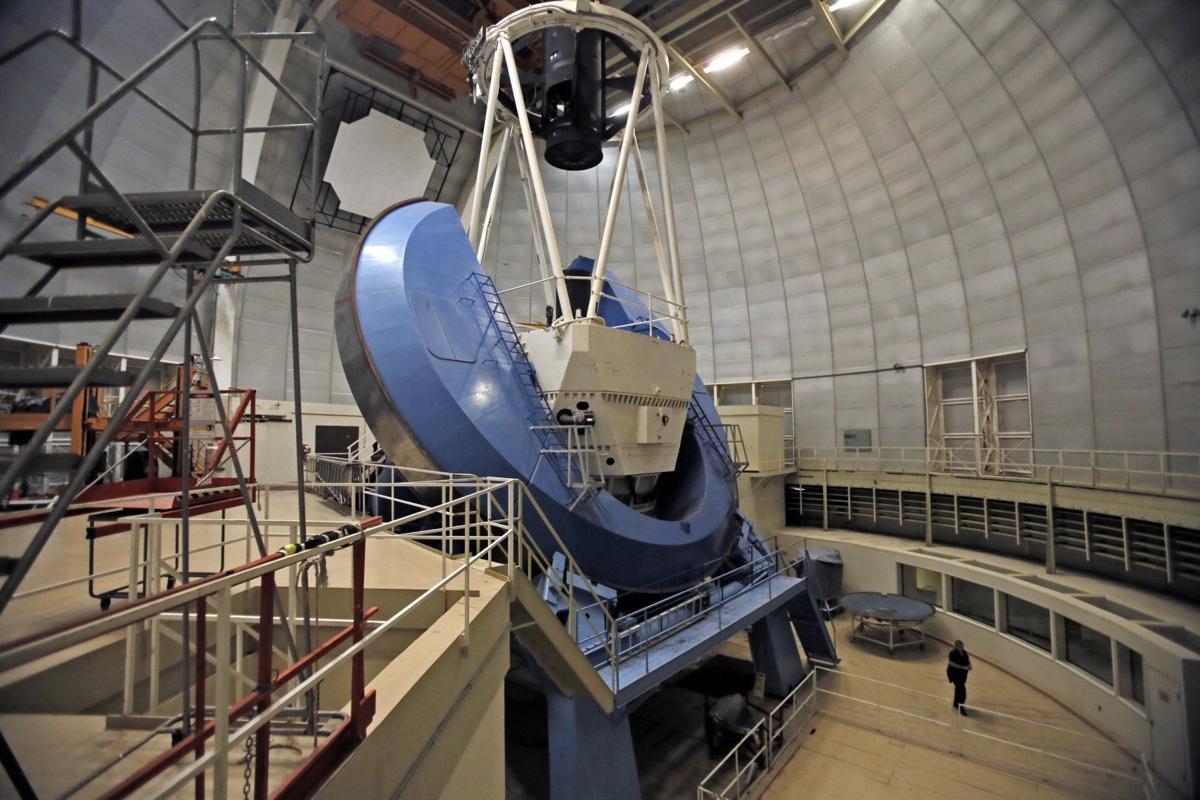
The original photographic plates for the project were taken in Oct 1974 with the newly installeNicholas U. Mayall Telescope


Below is the website to the source of my information

http://ned.ipac.caltech.edu/level5/ANDROMEDA_Atlas/frames.html

-----------------------------------

This project was inspired by a fantastic website by Steve Gottlieb who images globular clusters in nearby galaxies. Steve is a deep sky observer who enjoys the obscure and offbeat targets.

 https://www.astronomy-mall.com/Adventures.In.Deep.Space/gcextra.htm

                                                            -----------------------------------

39 Photographic plates were taken each of 25 minute exposure. Months of painstaking work was done to complete the Atlas and it's list of extragalactic clusters.


I unfortunately do not own anything in the order of the 4 metre Nicholas U Mayall just a modest 100mm refractor that's about 40 times smaller. I accept that a modern CMOS sensor is infinitely more sensitive today that a photographic emulsion. I spent about a week aligning the plates to mine and came up with an amazing 244 Globular clusters in M31 and it's satellite galaxies. It has been a fun project and I would encourage you all to have a go yourself. My Image below.


Saturday, 19 September 2020

Heart & Soul Nebula Nebula

I am fascinated by the latest Hubble palette processing for OSC cameras. I thought I would have a go with the Heart & Soul nebulas in Cassiopeia. There are more and more videos on You Tube. Both images are a little over 4 hours of exposure time captured with the Optolong L-enhance filter. This is solely my creative interpretation of that style as I have not figured out yet how to extract the Ha & Oiii from the master and recombine. Every time I have tried it in APP I only get a black & white image despite what the You Tube videos show, something I am doing wrong somewhere..


As always comments are welcome.

Friday, 18 September 2020

Andromeda Globular clusters.

 I stumbled across a great website by Steve Gottlieb https://www.astronomy-mall.com/Adventures.In.Deep.Space/gcextra.htm who has spend some time studying the globular clusters of M31. Several hundred were found categorised and published first by Edwin Hubble in 1932, As many as 509 globulars in M31 have been catalogued based on spectra plates taken at Mauna Kea with the 3.6 meter Canada-France-Hawaii telescope, (Crampton et al, 1985), although recent work indicates that some of these are faint background galaxies. In any case, the M31 globular cluster system does appear to be more numerous than our own galaxy by roughly a 2:1 ratio. This important article provides identifications, positions, magnitudes, colours and radii although no finder charts are given.

A few nights ago I was testing the ASIAIR Pro auto focus and aligned on The Andromeda Galaxy. An hour later I stacked an hours worth of data and stretched it. I was truly amazed I was able to resolve 2' clusters @>mag15. Resolving deeper & longer is a passion of mine and my project a few years ago labelled hundreds of PGC galaxies in the Coma Cluster, this intrigued me from the outset and I had to see how many I could find in M110 (NGC205)

It didn't take long to find them all.


My image is on the left. incredible detail for just 1 hour of exposure. Spectacular rounds stars with of .42 arc second guiding accuracy.


My next project during the new lockdown will be to catalogue the Globulars in M31. I have found quite a few already but it looks like it may take a while.

Monday, 14 September 2020

M33

Some people like dairy milk, some like a Wispa me I love a good Galaxy. How about this one. About 2.8 billion light years away. M33 the Triangulum galaxy is part of the local group. I am sure there is another Astro Geek on a planet surrounding one of it's 40 billion stars looking over the galactic fence at us here. A very diffuse object I can't say I have seen it naked eye, others claim too but a wonderful sight in binoculars and a wide field eyepiece. Five hours worth of data for this one.

Image 1 is calibrated in Deep sky stacker and processed in Photoshop.


Image 2 is calibrated in Astro Pixel Processor and processed in Photoshop.

What an incredible difference.

Thursday, 3 September 2020

Veil Nebula

Giant stars are notorious for loosing their mass in the form of a super Nova The source of the Veil remnant was a star that exploded around 7500 years ago, Covering a huge area of sky appox. 36 times the area of the full moon. 

The Eastern Veil below is just a small section of the entire complex with a multitude of it's own nicknames like the Bat Nebula or Network Nebula.


The Western Veil is I think much more photogenic piece of the galactic puzzle commonly known as the Witches broom, Filaments of Hydrogen, Oxygen and Sulphur radiate light at different wavelengths and stretch across the sky in a twisted dance,


Friday, 21 August 2020

The Bubble Nebula

When radiation from a star several hundreds of thousand times more luminous than our sun expels energy  at incredible speeds the result is what looks like the most delicate bubble. The bubble itself is approx. 10 light years across intermixed within a soup of galactic dust and gas around 11,000 light years away. 


Sunday, 16 August 2020

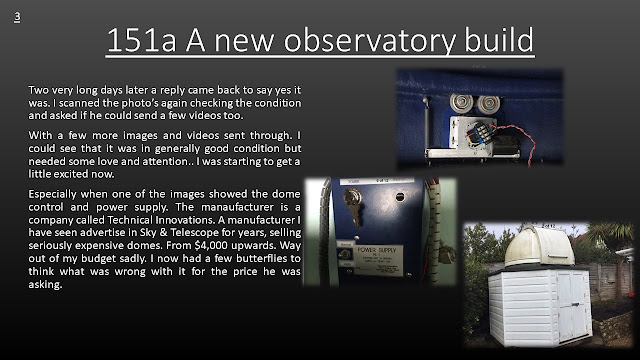
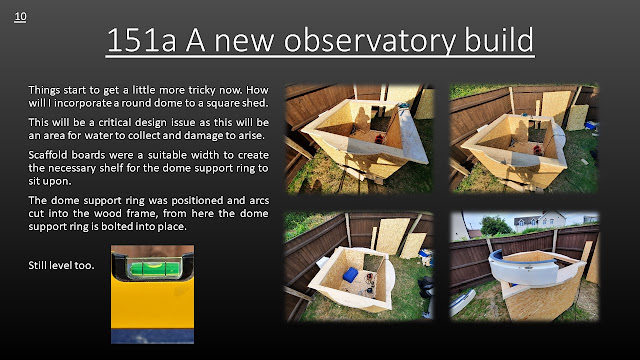
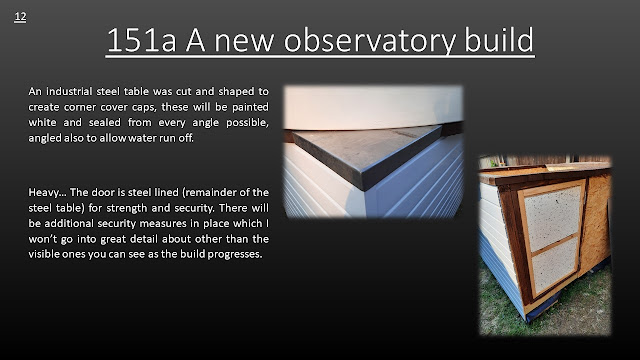
151a A new observatory build.


I have completed my new observatory build for my new scope. I have created a series of Powerpoint pages to show it's build.


If you have any questions please feel free to contact me, Enjoy


As mentioned above there are a few small jobs to complete before official first light.


Sunday, 12 July 2020

Comet 2020/ F3 Neowise

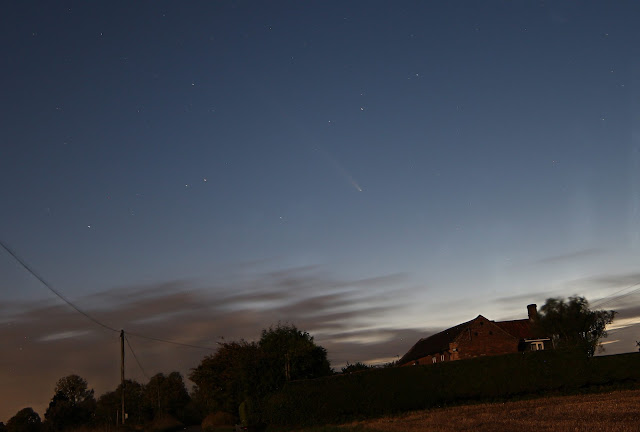
Imagine the year 4491. That's 2471 years from now. We certainly wont be here but comet 2020/F3 Neowise will be back. An absolutely beautiful sight visible to the naked eye. Unfortunately for me it is obscured by the houses opposite for a shot with the telescope. So a few images taken with the DSLR to show you.


Tuesday, 30 June 2020

C/2017 T2 Panstarrs

 When we think of comets we instinctively think of Halley's Comet that swings by once every 75 and a bit years. Halley's comet sweeps in from an orbit that takes it out to the planet Neptune and back. This little one  C/2017 T2 Panstarrs has a little longer journey to make of nearly half a million years. So truly a once In a lifetime look at this cosmic interloper.


Monday, 29 June 2020

Pelican Nebula/ North American Nebula

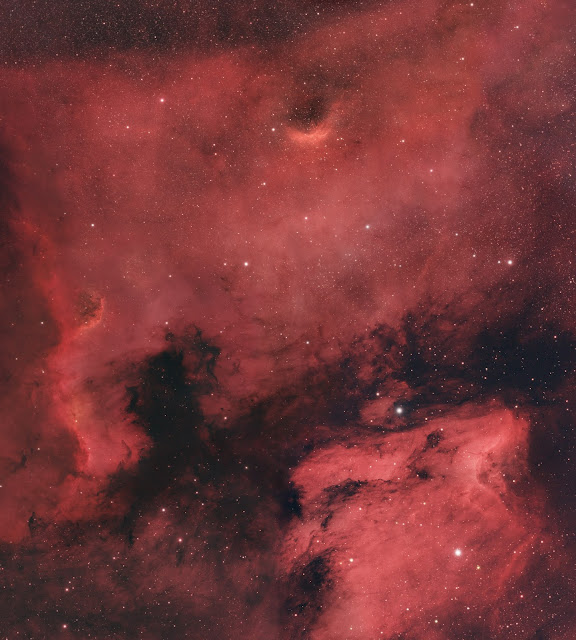
A favourite summer target has always been the Pelican Nebula IC5070. A wonderful target for us astrophotographers. As technology improves it forces us back for longer exposure, improved guiding building mosaics. But the one thing we always seek is a better image smoother, sharper better contrast. Looking at back at my early images through the DSLR's it's hard to believe we were happy with them. Always seeking those small improvements to create the perfect image.

New and old

Old and new


A mosaic of just 3 images has created this image. My first real attempt at bringing multiple long exposures into one. A total of approx 12 hours in total captured over a couple of weeks.


Wednesday, 24 June 2020

M27 The Dumbell Nebula

I never get bored of the Dumbell Nebula. I love the way it just floats there in the cosmic abyss. It was the first planetary Nebula discovered by Charles Messier in 1764 so not a lot has changed in the last 250 years or so. In 1970, its velocity was estimated at 31 km per second giving an expansion of about  2.3" per century. 

My equipment is still quite new to me so getting used to things more each session. However guiding tonight was erratic at just over 1' RMS.  I am hoping to start on the new observatory soon still though deciding on the design.


Comet Tsuchinshan-ATLAS, C/2023 A3 , Comet A3,

  A cosmic wanderer, Comet Tsuchinshan-Atlas or more commonly known as Comet A3 has traced its elliptical path through the solar system, a j...