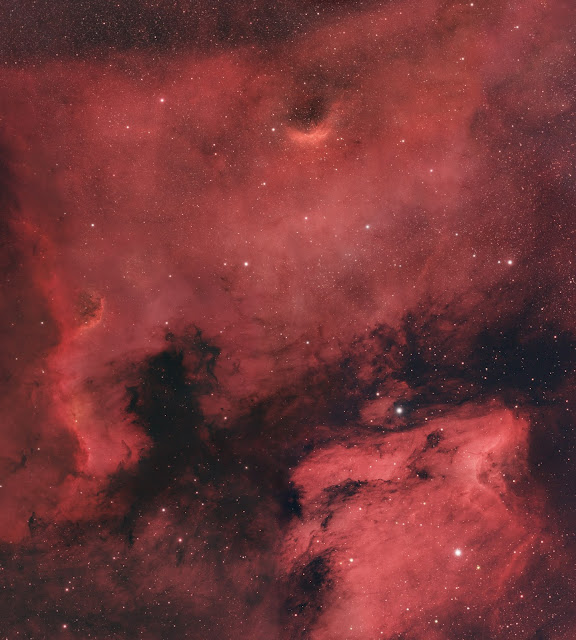
I am fascinated by the latest Hubble palette processing for OSC cameras. I thought I would have a go with the Heart & Soul nebulas in Cassiopeia. There are more and more videos on You Tube. Both images are a little over 4 hours of exposure time captured with the Optolong L-enhance filter. This is solely my creative interpretation of that style as I have not figured out yet how to extract the Ha & Oiii from the master and recombine. Every time I have tried it in APP I only get a black & white image despite what the You Tube videos show, something I am doing wrong somewhere..
Saturday, 19 September 2020
Heart & Soul Nebula Nebula
Friday, 18 September 2020
Andromeda Globular clusters.
I stumbled across a great website by Steve Gottlieb https://www.astronomy-mall.com/Adventures.In.Deep.Space/gcextra.htm who has spend some time studying the globular clusters of M31. Several hundred were found categorised and published first by Edwin Hubble in 1932, As many as 509 globulars in M31 have been catalogued based on spectra plates taken at Mauna Kea with the 3.6 meter Canada-France-Hawaii telescope, (Crampton et al, 1985), although recent work indicates that some of these are faint background galaxies. In any case, the M31 globular cluster system does appear to be more numerous than our own galaxy by roughly a 2:1 ratio. This important article provides identifications, positions, magnitudes, colours and radii although no finder charts are given.
A few nights ago I was testing the ASIAIR Pro auto focus and aligned on The Andromeda Galaxy. An hour later I stacked an hours worth of data and stretched it. I was truly amazed I was able to resolve 2' clusters @>mag15. Resolving deeper & longer is a passion of mine and my project a few years ago labelled hundreds of PGC galaxies in the Coma Cluster, this intrigued me from the outset and I had to see how many I could find in M110 (NGC205)
It didn't take long to find them all.
My image is on the left. incredible detail for just 1 hour of exposure. Spectacular rounds stars with of .42 arc second guiding accuracy.
My next project during the new lockdown will be to catalogue the Globulars in M31. I have found quite a few already but it looks like it may take a while.
Monday, 14 September 2020
M33
Some people like dairy milk, some like a Wispa me I love a good Galaxy. How about this one. About 2.8 billion light years away. M33 the Triangulum galaxy is part of the local group. I am sure there is another Astro Geek on a planet surrounding one of it's 40 billion stars looking over the galactic fence at us here. A very diffuse object I can't say I have seen it naked eye, others claim too but a wonderful sight in binoculars and a wide field eyepiece. Five hours worth of data for this one.
Image 1 is calibrated in Deep sky stacker and processed in Photoshop.
What an incredible difference.
Thursday, 3 September 2020
Veil Nebula
Friday, 21 August 2020
The Bubble Nebula
When radiation from a star several hundreds of thousand times more luminous than our sun expels energy at incredible speeds the result is what looks like the most delicate bubble. The bubble itself is approx. 10 light years across intermixed within a soup of galactic dust and gas around 11,000 light years away.
Sunday, 16 August 2020
151a A new observatory build.
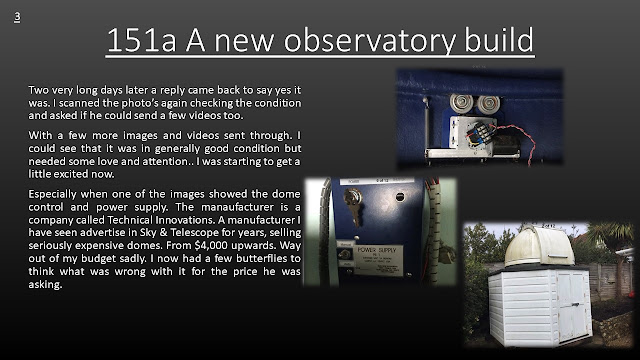
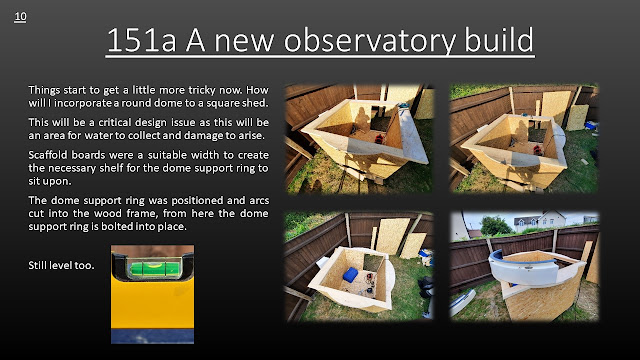
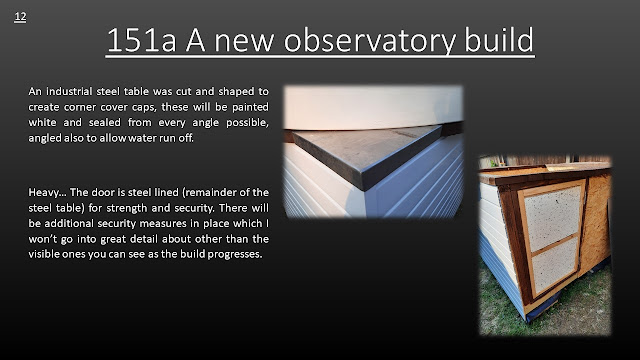
I have completed my new observatory build for my new scope. I have created a series of Powerpoint pages to show it's build.
If you have any questions please feel free to contact me, Enjoy
Sunday, 12 July 2020
Comet 2020/ F3 Neowise
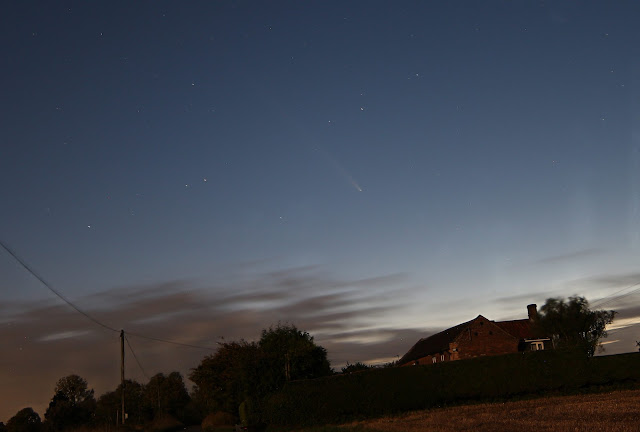
Imagine the year 4491. That's 2471 years from now. We certainly wont be here but comet 2020/F3 Neowise will be back. An absolutely beautiful sight visible to the naked eye. Unfortunately for me it is obscured by the houses opposite for a shot with the telescope. So a few images taken with the DSLR to show you.
Tuesday, 30 June 2020
C/2017 T2 Panstarrs
Monday, 29 June 2020
Pelican Nebula/ North American Nebula
A favourite summer target has always been the Pelican Nebula IC5070. A wonderful target for us astrophotographers. As technology improves it forces us back for longer exposure, improved guiding building mosaics. But the one thing we always seek is a better image smoother, sharper better contrast. Looking at back at my early images through the DSLR's it's hard to believe we were happy with them. Always seeking those small improvements to create the perfect image.
New and old
Old and new
Wednesday, 24 June 2020
M27 The Dumbell Nebula
I never get bored of the Dumbell Nebula. I love the way it just floats there in the cosmic abyss. It was the first planetary Nebula discovered by Charles Messier in 1764 so not a lot has changed in the last 250 years or so. In 1970, its velocity was estimated at 31 km per second giving an expansion of about 2.3" per century.
My equipment is still quite new to me so getting used to things more each session. However guiding tonight was erratic at just over 1' RMS. I am hoping to start on the new observatory soon still though deciding on the design.
A night of two targets
The California Nebula
The California Nebula NGC1499 is an emission nebula located in the constellation of Perseus located along the Orion arm of our galaxy roughly 1000 light years away. Energetic particles exciting gas are creating a huge nebula, all created by that little blue fellow just below the centre of the image. I say little Menkib is actually about 20 times more massive than our sun and burns hotter than 25,000 degrees. Captured with the Optolong L-Enhance 2" filter perfect for those faint Ha regions.
Comet Tsuchinshan-ATLAS, C/2023 A3 , Comet A3,
A cosmic wanderer, Comet Tsuchinshan-Atlas or more commonly known as Comet A3 has traced its elliptical path through the solar system, a j...
-
ASTRONOMER: When you rearrange the letters: MOON STARER Does anyone know any more that are astro related??
-
My previous post of M97 & M108 required further inspection as I could see numerous faint fuzzies about 20 in all. I have highlighted the...