Tuesday, 2 April 2013

M99, M100

Saturday night was a moonless clear night and at that point I was unaware of a new supernova in the galaxy M65. My scope was trained a few degrees away into Coma and caught a wide field image of M99(below) & M100(right) Both on average 55 Million light years away. I was testing the setup on 5 minute subs. Unfortunatly I have no stock of 300 second dark frames so the final wide field wasn't upto my usual standards. So rather than waste it I have cropped them and here they are. Please note M100 was very close to the edge of the frame. Stars are not perfect.

Supernova in M65 SN 2013am


Spotted on March 21 that M. Sugano, of Kakogawa, Japan had spotted a new supernova in the galaxy M65 – the 65th entry in Messier’s catalog of 110 objects – amateur astronomers expected the star to brighten to magnitude 11 or 12, shiny enough to nab in even a pedestrian 4.5-inch reflector.

Only 7 days previous I had spent the first clear night since christmas. I though I would have a go at an old favourite the Leo triplet. From my image below M65 is the upper galaxy of the trio and of course no supernova. The next clear sky opportunity I get I will have another go and image my second supernova. Previous in M95 last year. http://www.malcsastro.blogspot.co.uk/search/label/M95

Within a week, a typical nearby supernova beams brightly enough to show in amateur telescopes. Not 2013am. It’s been 10 days and the star remains stubbornly faint. Professional astronomers examined the light of the supernova on March 22 and gleaned a couple interesting tidbits. First, the blast is tearing the it apart, sending debris into space at over 4,300 miles (7,000 km) per second. Second, the star’s light is “reddened” or dimmed by dust along our line of sight.

Thursday, 14 March 2013

It's About Time.

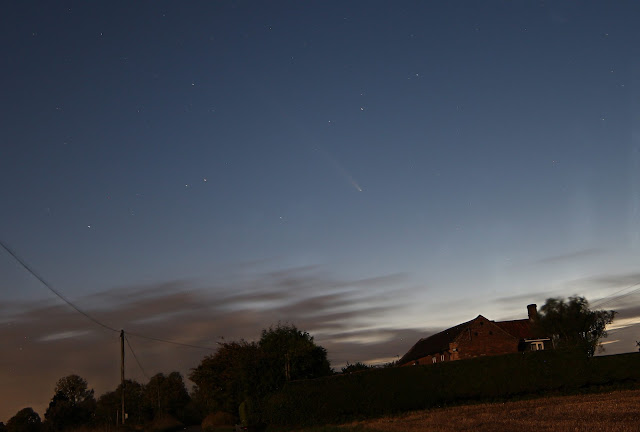
Comet C/2001 L4 PANNSTARRS has finally graced our northern hemisphere skies. This evening for me was a little frustrating. Located below a new moon it should have been visible. Except there was a horizon of cloud that stayed put for the duration. It was good to see via facebook a couple of fellow bloggers and Breckland AS society members, Dr Dan Barnfield Bob catch a glimpse of the comet this evening.The skies however have cleared. The seeing not perfect but I have set the cameras in motion. Having done very little astronomy since christmas it feels good to get back to it. I had planned on a slight modification to my set up in which the 66mm guidescope would come off and used as a grab and go. My imaging scope would then be connected to an off axis guider and camera, thus lightening the load on my ageing mount. But unfortunatly the focusser just could not take the weight for the auto focus to work. So I have gave up on the idea and rebuilt the 66mm back on board. I have also increased the counterweight slightly and this seems to help with the guiding consistency. With this I wanted an easy target to test the system. I caught about 90 mins will process in the morning.

As promised from last night I managed to capture some photons of that were travelling through the darkness of space for 35 million years to arrive last night at my camera lens. This trio of galaxies all look slightly different as the galactic discs are tilted to different angles from our line of sight.The galaxy on the left is known as NGC 3628, seen edge on with obscuring dust lanes cutting across the plane of the galaxy. while the disks of M65(top) and M66 are both inclined enough to show off their spiral structure. There is evidence that all 3 galaxies have interacted with each other some 800 million years ago.

Sunday, 9 December 2012

Sir Patrick Alfred Caldwell-Moore, CBE, FRS, FRAS

A new star shines tonight in the heavens. I was at work today when I head the sad news of the death of Sir Patrick Moore I am sure we all have our own wonderful memories of him whether it was watching him on tv, meeting him at astrofest or just simply being in awe of a true great astronomer. An inspiration to generations of men, women & children to gaze to the heavens, for me it was that spark of eccentric genius that could entertain and leave you wanting more, thats what got me interested in astronomy when I was a child. I could go on for hours, but I guess we all would like to smile and think of our own special memory of a wonderful man.

I hope now Patrick you have all the answers to all the questions you have ever asked about our existance. But I guess using a great quote from the great man himself.

"We just dont know!"
 
 Rest in peace Sir Patrick.

Monday, 3 December 2012

Kemble's Cascade

Has it really been a month since my last imaging session?. Last night saw a couple of hours of frosty clear skies here in Norfolk. So I took every advantage before a high cloud cover appeared at 21.00hrs. I was a little disappointed I could only manage 42 Minutes of useful data though. I have seen recently a number of images of a wonderful asterism hidden away in the constellation of Camelopardalis. The pretty open cluster of around 45 stars make up NGC 1502 that does have an association with the aptly named Kemble's Cascade. I dont think I have enough data here to show it off to it's best. Imaging at ISO 800 a bit of a push as the moon wasn't all that far away. I was however really impressed with the framing. A perfect size for my set up.

Friday, 2 November 2012

Moon Mosaic no2


Typical ! I have the week off for half term and I feel lousy. Hot & cold sweats, blocked then runny everything. Just stuffed up and a headache this morning. They kids have had a movie morning watching some Disney classics. While 2 computers processed a ton of frames. 24 images make up this wonderful moon mosaic. I used the same technique as described before using EOS live record. I kept the camera on the same plane as I recorded each AVI. My attempt was to capture the whole moon but looks like I missed a couple of sections. So here is a crop of the best part of the image. Stacked in Registax 6 and the same wavelet sharpening on each frame was used. Photoshop then used to align the frames. No colour correction or other processing used. I know it is not perfect as my 2x Barlow claims it ED but I always get colour fringing on one side of the image. Considering it is only a 90mm refractor. I am quite pleased with the result.

Saturday, 20 October 2012

By Jove

My imaging set up is not designed for planetary imaging. But I couldnt resist having a go at the true king of the planets Jupiter. Taken with my 90mm refractor with the DSLR attatched to a 2 x barlow using 5 x live view magnification and video recording a stack of 500 frames aligned and stacked in registax. Wavelet sharpening and thats it. By no means an image of quality compared to some of the dedicated planetary imagers out there. I might have a go with our societies planetary imager on the 20". I will post the resulting image when it happens.

Wednesday, 17 October 2012

California nebula

As promised I have had another go at the huge NGC1499. I sometimes wonder how something as huge as this never made the messier catalogue.
I have managed and hour and a half this time and think I have a much smoother result.
45 x 2 minute guided exposures at ISO 1600. No darks , flats or bias frames added , subtracted or divided. I just love the new JMI focusser. so simple and quick to auto focus. I have had a long day at work today. Just can't think of anything else to add. Goodnight all....

Saturday, 13 October 2012

CHIPS

I am sure many people will remember the American tv programme CHIPS. Based on the Californian highway patrol motorcycle cops. Well I thought it was a good title for a post ha ha!!

Having spent most of the session imaging the wonderful Comet Hergenrother. I wanted to just have my first go at the huge California nebula NGC 1499 before closing up.

This image is very noisy as only 22 minutes were captured at ISO 1600. My 40D is unmodded so I was pleasantly surprised with the amount of red light captured. Also worth a session with the UHC filter too.  A target with good altitude for UK observers so I will definately revisit with some long exposure. Keep looking for the latest pics. I cant wait to see a difference. I was so pleased last year when I images the horsehead for the first time. A very smooth image with some fine detail was the result. shortcut to it here https://blogger.googleusercontent.com/img/b/R29vZ2xl/AVvXsEj5yUWG_b1MxqxKDpW1QfgK_NzPd_lrb4CaWiP1EfBa5ZZtaZeviBYKpWyLSVKw7iQYsQxIasCqc2FXrTZ6BsGgUveIJPOeBUciUfAI7PRGSUcWhsEgWVfbKdhMmTa1KpEn1gFWagxKv0Q/s1600/flame+horse+weirdcropped.jpg


Comet 168P/ Hergenrother

 
Great news for keen comet observers, a well known periodic comet has suddenly gone into a substantial outburst and is now visible through backyard telescopes. 168P/ Hergenrother is a short period comet which visits the inner solar every 6.9 years. Normally the comet glows at a sorry magnitude 15 however something happened - perhaps a new dust jet - which caused the comet to brighten considerably, recent visual estimates place the comet between magnitude 10.2 and 10.5 putting the icy visitor within range of 6" aperture telescopes. Here is an animation I made from 60 x 1 minute exposures. Visible in the top corner of Pegasus at present and moving it's way through to Andromeda.

This is my Animation of 60 x 1 minute frames.


60 X 1 minute frames stacked in Deep Sky Stacker and a little DDP

Monday, 1 October 2012

A billion Stars

Been a little busy recently, Going on holiday, Back to work, A set of nights, Sending eldest daughter to University, all plays havoc with the astronomy. I have been playing a bit with Maxim DL. I am trying to use the auto focus setup procedure and combine automation with exposure control. I still have a slight DEC drift and need to re centre the image by a few arc seconds every other exposure. So just trying to get everything sorted out. Andromeda was at a nice elevation so I thought I would have a little test.

This shot 2 Hour 13 Minute exposure in 3 & 5 minute subs. No dark frame subtraction, Flats or bias taken. Iso 1600. Canon 40D through my imaging set up. Comparing it to the others I have taken I think it is the best hands down. I would appreciate any feedback too!

My own criticism is that if I had taken a few short exposures I could tease out a little more detail in the core. Easily remedied as maxim has saved the camera rotation angel when I plate solved the image. So another visit sometime soon I hope. I might consider sending it to sky at night mag too.

Comet Tsuchinshan-ATLAS, C/2023 A3 , Comet A3,

  A cosmic wanderer, Comet Tsuchinshan-Atlas or more commonly known as Comet A3 has traced its elliptical path through the solar system, a j...