Thursday, 14 May 2015

M12 More than pleasing to the eye.

The globular clusters in the Milky Way are all estimated to be at least 10 billion years old and therefore contain some of the oldest stars in the galaxy. They contain an abundance of low-mass red stars and intermediate-mass yellow stars, but none greater than 0.8 solar masses. There are about 150 known globular clusters in the Milky Way. It is thought that globular clusters formed very early in the vast halo surrounding the nascent galaxy before it flattened to form the spiral disc. Star formation would have stopped in these clusters maybe 13 billion years ago, so only old stars are expected to be found there.

Described by Charles Messier as a nebula without stars, it's discovery almost 251 years ago this May 30th. M12 is fine example of a globular cluster, appearing to me visually in my 110mm as a compact dense core with a fainter outer shell. I have the luxury of shielding myself from extraneous light inside the observatory but I still like to cover my head with a dark towel and allow just the faint photons of light to touch the retinas. Somewhat smaller than M13 my eyes are drawn to the triangular shaped 3 stars to it's lower left resolving them to starlight points easily. I wanted to highlight that with this image taken Tuesday night with what was one of the best clear nights of the year. Just over 20 degrees above the horizon and tainted with the light from the nearby town of Watton. I limited exposures to 10 minutes and this was just about the limit as a gradient was becoming a problem. 2 Hours in total calibrated and stacked in Maxim and processed in Photoshop using several layers in an attempt to keep the core stellar like. My focus was a fraction off as 12th+ magnitude stars show a little blooming, noticable when stretched so I have sacrificed some of the background stars. Having never image M12 before I am pleased with the result.

Monday, 4 May 2015

3 pixels

I know there is still plenty of time to capture the spring galaxies. Well not for the next week at least with the full / waning moon spoiling the Eastern skies. However I started a Galaxy project The objective was another deep field to image as many of the Coma cluster of galaxies. First estimate was approx 1200 -1500. I will be happy with that.

 I  started with the accumulation of 3 hours in 20 minute subs with flats using the William Optics GT81 and starlight express camera. Resolution was 3.37"/pixel with a field of view at 2.83° x 1.88°. I also captured another 5 hours 40 minutes from the FLT110 TMB with darks and flats. Resolution would provide 2.09"/pixel. in a 1.75° x 1.17° field. Unfortunatly I did not manage to keep the angle of camera rotation the same so the final fov would be somewhat smaller. Calibration worked  reasonably well in Maxim, a few hot pixels remaining not 100% happy with the flats from the 81mm either. The 81mm frames scaled to the 110mm's ok though. Processed with just levels and curves in photoshop. Definately a gradient there. I will have a go at that later.

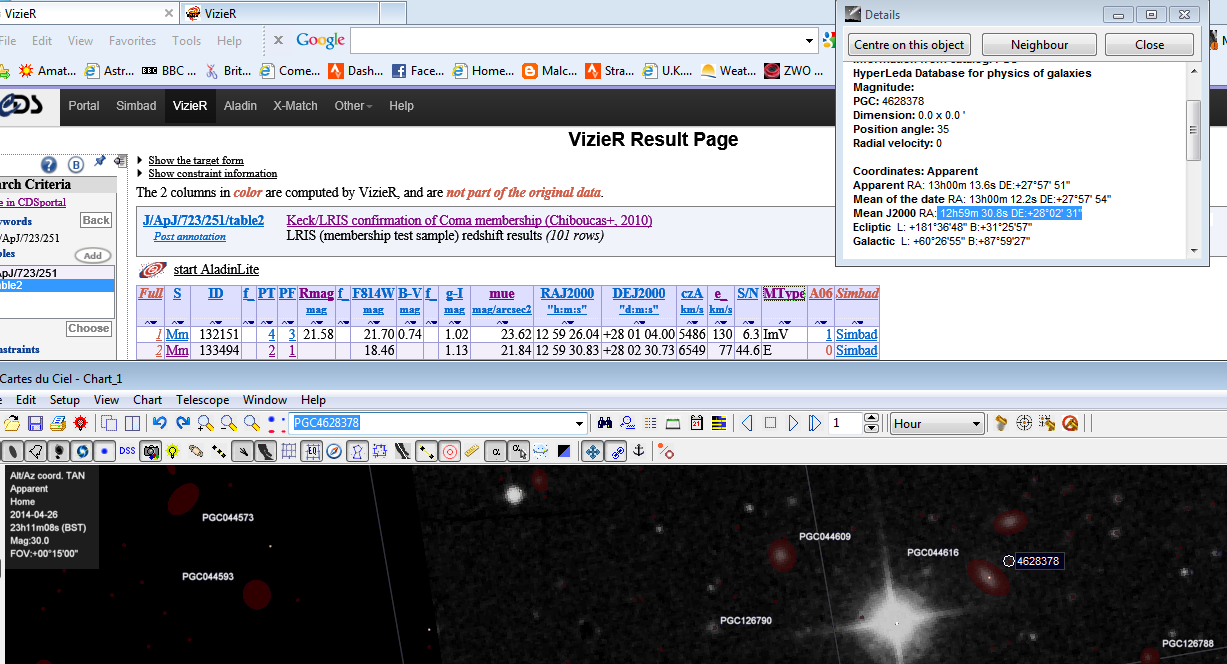
Platesolved in Maxim DL and compared against Carte du ceil. I have several faint galaxy catalogues added and immediately CDC filled with little round circles. I am certainly not going to label all of these???. With probably only a few dozen of our own galaxies stars in the field, everything else is a galaxy mostly from the Coma cluster. This is where the fun begins. CDC labels the PGC galaxies to magnitude 20 anything deeper just leaves a blank. One particular example was labelled PGC 4628378. Listed as 0.0 x 0.0 ' in size and no magnitude it states it's listed under the HyperLeda Database for physics of galaxies. A complex search of 13,000 databases made the task somewhat tougher than I expected as there have only 6 bibliographic references have been made since 1950 on this object. The Hyperleda database splits into many sub categories and redesignated our fuzzy as GMP3397. This was confirmed by the use of Aladin and images gathered by the Sloan Digital Sky Survey SDSS. (pictured). I also cross referenced the data with the Keck/LRIS spectroscopic confirmation of Coma cluster dwarf galaxy membership assignments 2010.

This was starting to gather pace like finding a great great great uncle on Ancestry.com.

Using the VizieR Online Data Catalog: GMP catalogue: galaxies in the Coma cluster (Godwin+ 1983). Classification confirms it is a galaxy within the cluster one of 6724 with a magnitude >21 in a 26.3 degree square area centered on the Coma cluster.

Size appears to be 6 x 4 arc seconds. So resolving at 2.09"/pixel that would equate to around 3 pixels on the camera sensor at magnitude 21.84. Bottom left is a 800x zoom and inverted image of the location, CDC photographic plate is on the right. Finally on the left show 3 pixels that are a few shades lighter than the background. This confirms the deepest I have ever imaged.

The 2nd line confirms RA and Dec and a magnitude of 21.84

Saturday, 25 April 2015

The sky at Night.

I can finally tick off appearing on The sky at night tv programme from my bucket list. I was lucky enough to have my image of the Horsehead nebula appear with myself and Pete Lawrence on the programme. The interview involved 2 pieces to camera with a number of questions asked. Final edit and broadcast was reduced to about 30 seconds. As mentioned before this is the second time the team has visited Breckland AS. An open invite was given to return if we can offer anymore future programmes.

Star trails

Star trails from Saham Hills observatory


The last time I imaged star trails was with my old Olympus OM1 film camera back in Somerset.
I have seen a few really nice compositions on various Facebook pages using a free programme
http://www.startrails.de/html/software.html .A very simple programme to use. Take the images load into programme and select the trail type and go. In a short while you have a fantastic pic like this.
 
 The sequence is 150 x 40 second images from the Canon 40D and 18-85 IS USM lens @18mm Iso 400.
Capture started at 21.22 hence the deep blue sky. The bright star at bottom right is Vega rising. I am sure I will be posting many more of these before the year is out.


New Life in an old focuser

I tested a replacement focuser for the 110mm unfortunately it doesn't fit due to the 4" fitting on the 110. Having removed the existing I decided to have one more bash at trying to get the darn thing moving. I have the technical diagram for the focuser and decided to adjust the bolts that state should only be adjusted by an engineer. What the heck it's busted so what's the worst I can do. Fix it!!!!!

So 20 minutes later I have a reasonably smooth movement going, readjusted the tension to take the weight of the field flattener and camera. On it went and bingo it worked in both directions. I don't think I want to remove the camera ever again.......


A rebalance of the scopes was required to bring back the Starlight camera back into operation. 
A lovely flat field test has resulted in sharp round stars at the edges of the frame too. I took 40 sky flats and created a decent master. Dark frames also captured for a full calibration. I like to use a median setting in Maxim DL as this gives best removal of hot pixels. 5,10 & 20 minute guided exposures have given me a very smooth finish. Processed in Photoshop. The best image of M13 I have taken has resolved stars to the core. The somewhat forgotten Ngc6207 is showing structure and threre are a few more little galaxies easily visible. A PGC galaxy 3515221 can also just be seen at mag 19.64. This side by side inverted image and CDC chart confirms its location.


An inverted image of the core

Saturday, 4 April 2015

Jupiter


Some recent captures under less than average seeing. Using my ZWO ASI120MC camera and the clubs Celestron C9.25 with a 2x Barlow lens. Captured at 11 frames per second approx 90 seconds of recoding to avoid image rotation. The best 50% of frames captured was the result. My best capture of the Great red spot I like the small white disturbance into the south equatorial belt, that defines the red spot nicely. I can also see  some lovely striation detail to the North Belt. I am pleased with it despite the seeing, but not as happy as I would like when seeing some of the other jupiter images posted on Facebook groups. I will of course endeavour to get a little more each capture and produce an image worthy of publicaion.


I am very happy with this image capture of Jupiter and Ganymede. A steadier atmosphere gave a small improvement to the overall image quality. Captured to the right is Ganymede. It looked like a horrible blur at first. An RGB realign later has given a pleasing result to it's disk. I also gave a small increase in colour vibrance and some contrast adjustment. Some distinct patterns in the north & south temperate belts can also be seen. I have a few more Avi's to process and I will add to this post if anything new comes from them..


Saturday, 28 March 2015

The Sky at Night Update.

Last night was an amazing night for me and the society http://www.brecklandastro.org.uk/. For the second time now we played host to the sky at Night crew to take part in Aprils show that pays homage to the Hubble space telescope and it's 25 years of service. The focus of the show will be the iconic images produced by hubble. The club members had selected thier own favourite & best images for targets that hubble has imaged and the crew selected a few for the show. Richard's, Bob's and my own images were selected. We each done a piece to camera answering questions from Pete Lawrence. Living in hope they don't end up on the cutting room floor. The show will be broadcast on April 12th on BBC4

Saturday, 21 March 2015

The Sky At Night

Our society http://www.brecklandastro.org.uk/ will once again play host to the Sky at night team. Hopefully the weather will hold for some observing. I hope to show the team some of my deep images showing the mag 20+ galaxies & quasars I have captured. The topic is Hubble's "Deep field" to coinside with it's 25th anniversary. I hope they will be interested. Watch this space for an update.

Solar eclipse or not........

Diary entry for March 21st 2015 just reads "Bugger"

Alas the weather as usual blotted out ANY view at all of the solar eclipse. Right on cue at 11.30 the skies cleared to reveal what the remainder of a lovely spring day. I am of course disappointed that I didn't get to see anything. However I get get some pics of the Jan 4th 2011.


 So at least this post is totally wasted.

Wednesday, 25 February 2015

A trio in Leo.

Unfortunately I have been ill and off work these past few months and my astronomy has taken a back seat. along with my cycling and my passion for just about everything that means the world to me.  I have been outside just 3 times since. I am now thankfully on the road to recovery with the support of my wonderful partner & family plus some great close friends. Mentioning no names Des & Phil oops, and once again my love for astronomy and everything else is returning. Also a big thanks also to all my colleagues that have asked after me at work. most of which have a gander as to what this astro geek gets up to at night. I enjoy talking to you guys & gals about my amazing hobby.
 -------------------------------------------------

Looking back over some old images. I found the ever popular Leo triplet of galaxies. Taken with the Canon 40D. I knew I could improve on it so that was the nights target. Taken through the Williams Optics GT81 and using 20 minute guided sub exposures. Calibrated with Dark frames in Maxim DL5. Processed in photoshop. This final cropped image is 3 hours of data. A very pleasing result Perfect focus and some lovely lane structure in all 3 galaxies.


Me being me I wasn't just satisfied with that. So I loaded Carte Du Ceil and had a closer look. I downloaded the PGC Principle Galaxies Catalogue and brought up my field of view.  The field lit up with large number of very little red dots. I loaded side by side Photoshop with my image. It soon became very clear that I had a deep image. The 15th- 18th magnitude galaxies were easily visible. After finding a few dozen I thought I should mark them and see how many I could find. There was a few places I must have missed as I seem to be adding more each time I    look. So far the total is 153 and counting.

The fainter galaxies were somewhat more of a challenge.


The image has been plate solved and I needed this to locate and verify the position of the objects that were barely visible even at 400 x  zoom in Photoshop. But I did find that an inverse of the frame gives greater contrast as some of the faintest smudges are just a couple of shades brighter than the background.

Incredibly small movements in the mouse movement moved the RA and DEC by arc seconds across the frame and CDC confirms the location of PGC 3542189. As I mentioned earlier the subtle difference in colour in the centre of the square with a contrast boost and inverted. reveals the presence of this Magnitude 20.31 Galaxy. Position confirmed as RA:11:18:17 and 
DEC :13:03:11. Unfortunately I am unable to find any information on the galaxy type or distance / redshift other than it has been catalogued.

 ------------------------------------------------

 I just picked up on my emails to learn  that our society http://www.brecklandastro.org.uk/ will again host the presenters of the Sky at night programme for a piece based on the HST. and it's deep field images. I think I will point the scopes next clear night and put in a contribution of my own deep field. They may be interested in what I have just done as well as a previous post on M97 & M108 with some very distant quasars. We will wait and see.

Tuesday, 13 January 2015

Comet C/2014 Q2 Lovejoy animation

They say an image speaks a thousand words.
So for me an animation speakes a whole volume.
This will be the 3rd animation I have done that shows the movement
of a comet. This one is of course Comet C/2014 Q2 Lovejoy.


26 Frames of 2 minute exposures. Animation created in Maxim DL after a DDP stretch, & Crop in Imagesplus.
 
I hope we get a few more clear nights to have another go. Rapidly moving North also it has  moved over 10 degrees in 3 days since imaging on Saturday night.

Comet Tsuchinshan-ATLAS, C/2023 A3 , Comet A3,

  A cosmic wanderer, Comet Tsuchinshan-Atlas or more commonly known as Comet A3 has traced its elliptical path through the solar system, a j...