Saturday, 12 June 2021

M101 The Whirlpool Galaxy

I dread galaxy season fearing I can never do it justice using a 100mm F5.5 refractor. However come summer I am never too disappointed and the collection of targets from the spring skies, This particular night a couple of months ago now I remember the east / southern  sky was very patchy and galaxies there were going to be a challenge, so I aimed near vertical and collected 295 minutes of light on M101. Definitely under processed as there is a lot more faint structure to tease out. 


I used my goto astro survey software Cartes du Ceil and fund several dozen 21st Mag galaxies. NGc5474 does not look to shabby either.

Thursday, 3 June 2021

Juno

 The dark is a lonely place.

Since the formation of the solar system some 4 billion years ago, millions upon millions of rocks or asteroids are caught in an endless dance in orbit between Mars & Jupiter. 99.9% are no bigger than a London bus but some just some are a little larger.
Travelling at 18km per second I managed to capture movement of approx 32,000km during 30 minutes worth of exposure last night of the 320km asteroid 3 Juno. You can see from the cropped image the elongated shape due to the movement over that time. I have created a little repeating animation of the 15 frames to show the movement.


Juno was the 3rd asteroid discovered in 1804 and believed to be about the 10th largest in size.


Friday, 14 May 2021

Rosette Nebula.


The long winter nights have gone but some of those iconic targets are not forgotten, had a reprocess on this winters attempt of the Rosette Nebula. I think over the years my processing style has changed and improved, I like a more natural colour palette. Saying that I am looking at a full mono set up with LRGB HSO filters. Just 45 minutes worth of data here captured using the Optolong L-enhance filter in my ZWO filter draw.


The Horsehead Nebula

The winter months were not great from my location, that and the bloody tree facing due south, I only managed just over an hour on this iconic target, it beats too the image I took when featured on the Sky At Night Programme when Pete Lawrence visited our Society Breckland Astronmoical Society to celebrate the 25th Anniversary of Hubble. New image at top.  I know heavily cropped but an amazing difference in camera technology and processing technique.


Wednesday, 12 May 2021

M97 & M108 The Whale & The Surfboard.


The owl and the surfboard. I have previously mentioned the astronomical names of objects often resemble what they look like. Two prime examples are M97 the Owl Nebula & M108 the Surfboard Galaxy. The Owl is a planetary nebula, (not a planet) but the violent death of an exploding star, ejecting shells of gas & material into space, Still expanding some 8000 years later at 35km per second, can you see the owls eyes? M108 the Surfboard Galaxy lies some 2000 times more distant at 26 Million light years. Another example of a Galaxy viewed edge on from our perspective and uncannily resembling a surfboard.


Tuesday, 11 May 2021

M106

There are a handful of Galaxies that present themselves at such an angle you get to see the the immense spiral structure, dust lanes and nebulae in all their splendour at once. M106 is one such beauty right above us this evening. 5 minute sub exposures controlled via the ASI air pro2 reveal some amazing structure in the spiral arms and dust. Numerous other fuzzies are clearly visible within the frame and one immediately caught my eye as the first frame came in is Ngc4217. Believed to me associated to M106, Ngc4217 is viewed edge on and has a very prominent dust lane splitting it in two from our perspective.  At 60 Million light years plus away, appears to me in sub frames very much like M104 The Sombrero Galaxy, my meagre 554mm focal length does not do it justice. Ohhhhhhhh for an 11" SCT. 


The screenshot is the a 5 minute sub frame for the ASI Air Pro. A revolutionary micro computer that has dedicated software for communication, Imaging, Guiding, Auto focus, Scope control and filter wheel (not used). The latest beta release now includes planning to allow multiple targets unattended. A typical imaging session starts with rolling back the dome shutter and power up. I have connected a TP Link travel router to provide greater wifi signal for control inside the house. It takes a minute or so to run it's start up and connect to my tablet. This connects automatically to the ASI Air pro and we are away. My permanent set up means polar alignment is not required every session so I can go straight to target and plate solve. I start a plan in tonight's case M106 from there I leave the obsy and return inside the house. It starts will cooling the main imaging camera to -10 then runs the auto focus routine, guiding initiates and starts guiding using multiple stars, when the guiding has settled the autorun of imaging begins. I have auto focus set to run every hour as in the dome I don't think I need the temperature probe.

 Currently into hour 2 and I have rejected a couple of frames as there are a few gusts of wind that cause the guiding jitters. So averaging at just over .50 arc sec guiding very happy with that. Just opened Carte du Ceil to identify a very faint dot around mag 15 to the north west of the galaxy. It identifies it as PGC 39615 a mag 16.05 irregular galaxy. I really enjoy seeking out  and identifying the obscure and faint within an image. 


Tuesday, 13 April 2021

Markarians Chain

With more Messier numbers and Ngc's than you scan shake a stick at Markarian’s Chain can be found on the outer edge of the Virgo constellation, Sandwiched between Denebola and Vindemiatrix, a small section of the Virgo Super cluster is aptly named Markarians Chain. You can see highlighted from the graphic that each galaxy looks like it is linked to the next to form this spectacular galactic chain. I wanted to frame this image slightly different but found myself reluctant to rotate the camera angle and the need for new calibration frames. I can't decide whether I like the horizontal or vertical view, let me know what you think.


Friday, 2 April 2021

Moon

 A while ago I imaged the moon with the DSLR and here are a few results. Not the highest of resolution or greatest of contrast and sharpness, but none the less images with my own fair hand and processed in a way I enjoy.


Thursday, 1 April 2021

California Nebula

 A rework of a previous capture. Using the new to me Arcsinh Photoshop curves processing. A piece of software designed for PIXinsight. Can be found here. Photoshop Colour Preserving Stretch (markshelley.co.uk) Along with a fantastic explanation and several You tube videos showing it's use. A great one from Astro Ed (1) Astrophotography: The ABSOLUTE BEST way to STRETCH your Astro Image data in Photoshop [PS]! - YouTube demonstrates some new techniques for the teasing of data from images, especially keeping those stars small too. I used two itterations and combined it with a Starnet++ frame. Not the cleanest of data but great fun to play with. 


Multiple M45 views

The Pleiades is always a favourite from Autumn to spring, 2020 saw a few different compositions. from a conjunction with Venus to an unfinished multi panel mosaic.


Leo Triplet

 I swear it is only ever clear the night of and after a full moon. Just my luck really, We have not had any decent nights for a while it seems, I wanted to get out and do something. I bought from                 U.K. Astronomy Buy & Sell (astrobuysell.com) a new Optolong  L Pro filter a light pollution filter that is more and more needed even in my rural location. Optolong LPS filter L-Pro for deep sky nebula consteallation photography-Optolong Optics Co.,Ltd

My only real unobstructed view is to the East and is the town of Watton is just 3 miles as the crow flies so the glow of the town radiates into view and the filter is needed. So my first test was the beautiful Leo triplet of galaxies. This image was taken over two nights using the filter and worked well I think. Only a very small gradient was noticed after some aggressive processing which was easily removed. I am quite happy with this image after some really poor seeing and the guiding on the first night never achieving better than 1.2 arc sec (usual average is 0.75.

59 x 5 minute sub exposures controlled with the ASIair pro2, stacked in Deep sky stacker and processed in Photoshop.


This trio is now accepted as part of the M96 group of galaxies and then part of an even larger group still.  I think to the accepted idea is also that M66 is a disturbed Barred Spiral. The front arm certainly looks like it has seen tidal interaction by a passer by whilst the rear arm looks somewhat undisturbed.


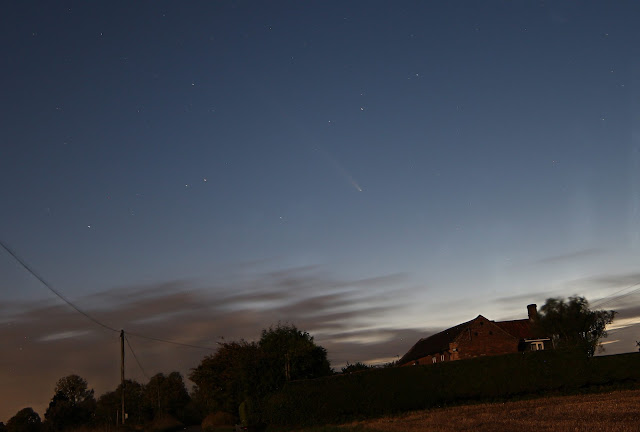
Comet Tsuchinshan-ATLAS, C/2023 A3 , Comet A3,

  A cosmic wanderer, Comet Tsuchinshan-Atlas or more commonly known as Comet A3 has traced its elliptical path through the solar system, a j...