Friday, 18 May 2012
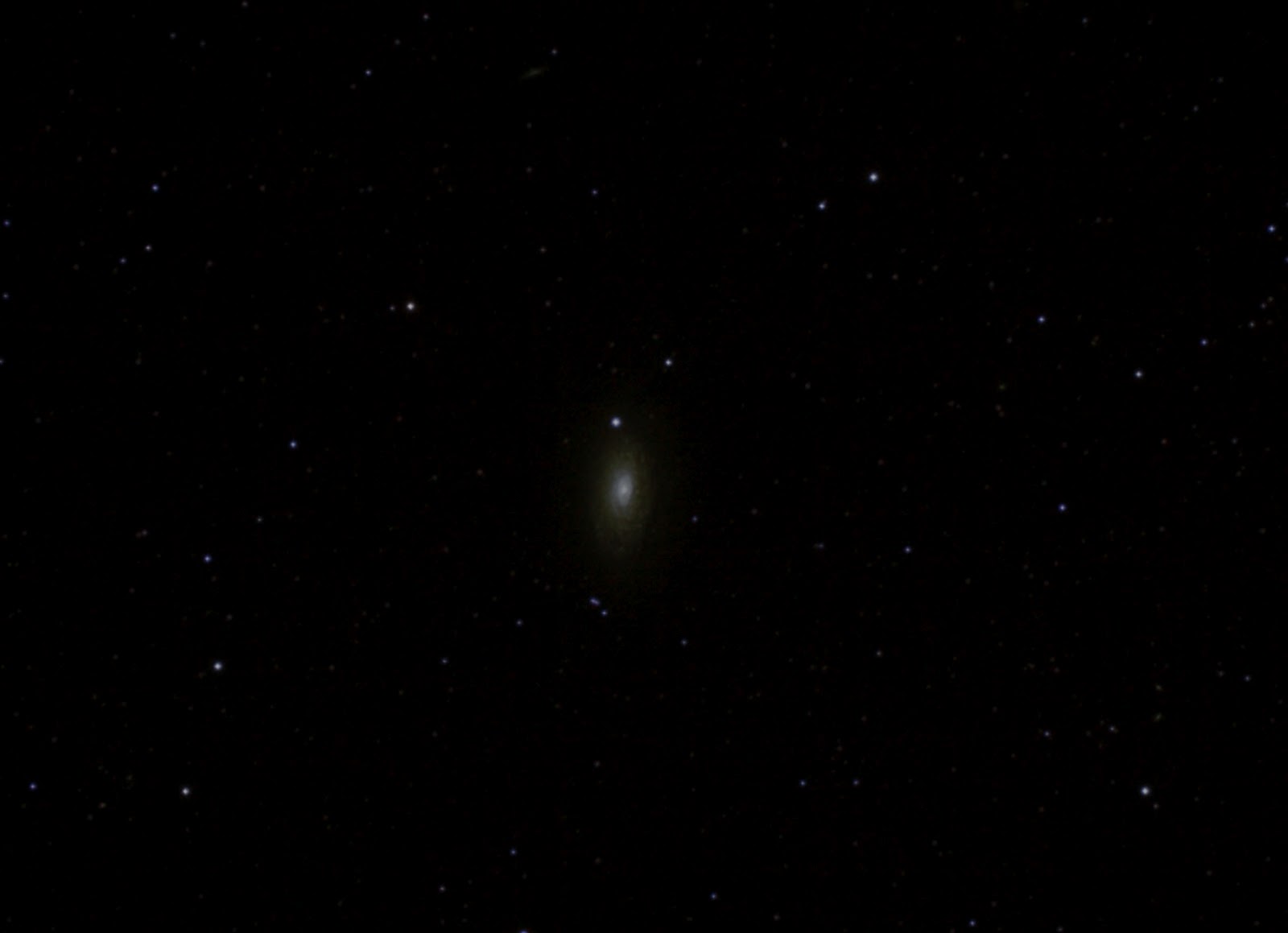
M63 Sunflower Galaxy
The first clear night in 5 weeks. I was desperate to get out and roll back the roof. M63 was my target. A central disk surrounded by a wealth of short spiral arm segments. A cropped 30 x 2 minute guided exposures at Iso 800. I am not really happy with the image. Sky quality was not amazing. I was just glad it was clear. I think a revisit will be required soon!


Monday, 30 April 2012
A new view of the moon


Thursday, 12 April 2012
An old favourite
After studying M13 through your telescope, imagine now the sky as from
deep within the cluster. We would see uncountable numbers of blazing
stars, many as bright or brighter than our naked eye planets.
Inhabitants on a planet inside M13 would probably know nothing of the
Galaxy and other galaxies, as their view would be completely blocked by
the brilliance of their own skies. To them, the Great Cluster in
Hercules would be "the Universe".

I wanted to try a few exposures at a low Iso and see how well the processing would keep noise to a minimum. The sky has remained very dark as the DDP stretch in Images Plus increased and teased out more detail. I wanted to capture more detail in the core, under saturating the chip at 400 ISO has worked well. Stacked in Deep Sky Stacker this is only 10 x 2 minute guided exposures. (This time I remembered to refocus after the alignment setup)
Monday, 2 April 2012
If it wasn't for bad luck
I would have no luck at all. Is how the saying goes. Mystic Malc predicted a couple of weeks ago that we would indeed have a good week of clear skies last week. So we did, BUT I was not going to see any of them. Last monday to this Sunday inclusive was my first set of nights on the night shift this year. Here continueth the run of bad luck.
 So if we skip back to last May I dismantled my observatory and packed everything away while we moved and of course missed Sn2011dh in M51 last June. Whilst I was building the new observatory last September I missed sn2011fe in M101.
On the 23rd of Feb this year I imaged a wide field inc M95
 and of course saw no Supernova See pic.Tonight is my first night at home again and guess what the clouds have rolled in. Am I destined to miss every Supernova.
To continue the run of misfortune. Last night 10/4/12 saw a reasonably clear. Google said the clear sky wouldn't last so I hastily set up and focussed on a set up star. Here in is where the problem lies M95 was a good 60 degrees across the sky and I completly forgot to refocus. Looks like a tenth of a mm out. But the good news is I have managed to get my first image of the sn2012aw.
 So if we skip back to last May I dismantled my observatory and packed everything away while we moved and of course missed Sn2011dh in M51 last June. Whilst I was building the new observatory last September I missed sn2011fe in M101.
On the 23rd of Feb this year I imaged a wide field inc M95
 and of course saw no Supernova See pic.Tonight is my first night at home again and guess what the clouds have rolled in. Am I destined to miss every Supernova.
To continue the run of misfortune. Last night 10/4/12 saw a reasonably clear. Google said the clear sky wouldn't last so I hastily set up and focussed on a set up star. Here in is where the problem lies M95 was a good 60 degrees across the sky and I completly forgot to refocus. Looks like a tenth of a mm out. But the good news is I have managed to get my first image of the sn2012aw.
Monday, 26 March 2012
Galactic Globulars M3,M53
I cant believe the good run we have had over the last week five from five here in Sunny Norfolk. I am feeling a bit gutted too as I have missed Breckland Astronomical societies first star party & I have a week of night to do starting tonight so the skies are bound to get even better!!. I shouldn't complain either as I have addeed a handful of Pics to my own messier chart
Having bagged a few galaxies this week I turned my attention to the old and weary (globulars) that is....

Having bagged a few galaxies this week I turned my attention to the old and weary (globulars) that is....
M5 & M53 became the clusters of choice.
M5
 Astronomers like Messier, Kirch, Koehler & Bode all described their first observations of M5 back in the mid 1700's as a nebula without stars. It wasn't until 1783 when William & Caroline Herschel viewed through their 7 & 20 foots reflector. it was resolved into the myriad of stars we can capture today. Although Caroline still mistook it for a comet.

M53 & Ngc 5053

M53 and NGC5053 are shown in this field. M53 is the bright globular cluster in the centre; NGC5053 is the dimmer globular cluster in the lower right. ngc5053 is about 53,500 light years distant from Earth which is close to the distance of M53. This puts both globular clusters relatively close to each other in space. I had made a slight miscalculation and thought I could not fit both in the same field of view. I only looked at the framing of M53 in my test image. I will have to have another go sometime framing them both appropriately.
Friday, 23 March 2012
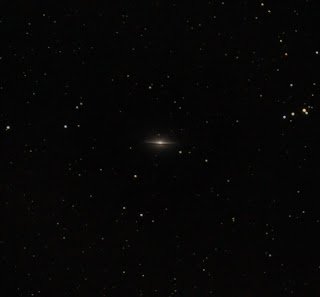
Sombrero M104
M98, M99
Discovered in 1781 the M99 (centre) galaxy has a normal looking arm and an extended arm that is less tightly wound. Floating like a cloud in the blackness of space some 50 Million light years away. The upper right of the picture gives us M98 A similar looking galaxy but from our perspective it is viewed nearly edge on. A little further at 60Mly. A blue shift has been measured at 140km per second. This means this galaxy is coming our way closing in every day. Dont panic it will still take 352 Trillion 183 Billion 933 Million 935 Thousand 630 years to reach us.

This image is a composite of 2h 30m in 3 minute guides exposures at Iso 1600 Deeps sky stacker processed in Images plus 3.82 and a RC Astro Gradient xterminator applied.

This image is a composite of 2h 30m in 3 minute guides exposures at Iso 1600 Deeps sky stacker processed in Images plus 3.82 and a RC Astro Gradient xterminator applied.
M101

My Image Is just 36 minutes composed of 12 x 3 minute unguided exposures at Iso 1600. Time was approaching 1.00am and some light cloud was approaching. I am always amazed at how much detail is captured on such a short lenth of exposure. I cant wait to get more!
M59, M60 Galaxies
The last couple of nights have been wonderfully clear. It's a shame I have had to work too next day, I closed up both nights just after 1.00am up again for 6.00am. My first target was was a couple of fuzzies of the virgo cluster. M59 and the mamoth eliptical galaxy M60. Harbouring one of the largest black holes ever found at about 4.5 billion solar masses. My image shows M60 and NGC4647 overlapping but there is no evidence to suggest the 2 are or have interacted in the distant past. At 55 Million light years away who know whats going on today.
 1hr 15 minutes at ISO1600 has revealed a wealth of detail I am pleased with. I hope to revisit and pick up a few more photons soon.

Saturday, 10 March 2012
3rd Tail for Comet Garradd
I was looking at a Nasa pic of the day today and the wonderful image was of of the heavenly interloper Comet Garradd. The image was taken on Feb 24th http://apod.nasa.gov/apod/ap120303.html and shows a 2nd Ion tail. My image of the comet was taken on the 22nd Feb and my previous pic was a stacked image using deep sky stacker aligning on the comet and tracking the stars.I see no sign of a 3rd tail. I reprocessed stacking the comet only and allowed the stars to trail. To my amazement I could see the hint of a newly formed Ion tail. I have not seen the tail on images prior to this so I may have captured the first jets of plasma as they slam into the magnetic fields in the solar wind.


Thursday, 1 March 2012

Subscribe to:
Posts (Atom)
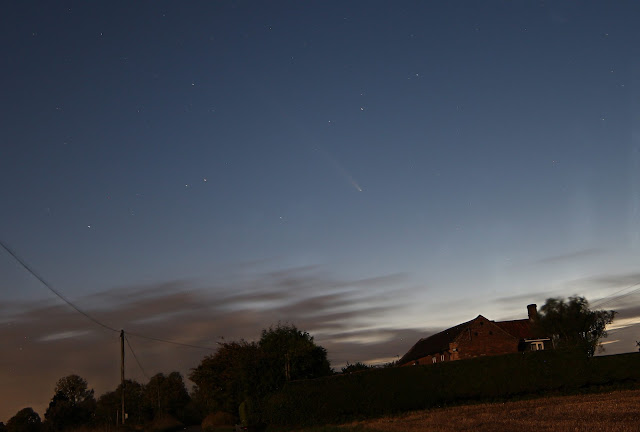
Comet Tsuchinshan-ATLAS, C/2023 A3 , Comet A3,
A cosmic wanderer, Comet Tsuchinshan-Atlas or more commonly known as Comet A3 has traced its elliptical path through the solar system, a j...
-
ASTRONOMER: When you rearrange the letters: MOON STARER Does anyone know any more that are astro related??
-
 A cosmic wanderer, Comet Tsuchinshan-Atlas or more commonly known as Comet A3 has traced its elliptical path through the solar system, a j...