M101 is relatively large 70% larger in comparison to our own galaxy. Lying approx 21 Million light years away. With over 3000 HII regions the galaxy is undergoing massive star formation.
My Image Is just 36 minutes composed of 12 x 3 minute unguided exposures at Iso 1600. Time was approaching 1.00am and some light cloud was approaching. I am always amazed at how much detail is captured on such a short lenth of exposure. I cant wait to get more!
Friday, 23 March 2012
M59, M60 Galaxies
The last couple of nights have been wonderfully clear. It's a shame I have had to work too next day, I closed up both nights just after 1.00am up again for 6.00am. My first target was was a couple of fuzzies of the virgo cluster. M59 and the mamoth eliptical galaxy M60. Harbouring one of the largest black holes ever found at about 4.5 billion solar masses. My image shows M60 and NGC4647 overlapping but there is no evidence to suggest the 2 are or have interacted in the distant past. At 55 Million light years away who know whats going on today.
1hr 15 minutes at ISO1600 has revealed a wealth of detail I am pleased with. I hope to revisit and pick up a few more photons soon.
Saturday, 10 March 2012
3rd Tail for Comet Garradd
I was looking at a Nasa pic of the day today and the wonderful image was of of the heavenly interloper Comet Garradd. The image was taken on Feb 24th http://apod.nasa.gov/apod/ap120303.html and shows a 2nd Ion tail. My image of the comet was taken on the 22nd Feb and my previous pic was a stacked image using deep sky stacker aligning on the comet and tracking the stars.I see no sign of a 3rd tail. I reprocessed stacking the comet only and allowed the stars to trail. To my amazement I could see the hint of a newly formed Ion tail. I have not seen the tail on images prior to this so I may have captured the first jets of plasma as they slam into the magnetic fields in the solar wind.
Thursday, 1 March 2012
Moon & Venus
Taken on the evening of the 25th Feb The moon passes close by the planet Venus At the time this was taken the moon was 248,819 miles Venus was 87,104,049 miles away making the moon a cool 350 times closer to us than venus. I just about managed to fit them into the same frame. I deliberatly over exposed the picture to get earthshine.It is caused by sunlight that reflects off the Earth onto the Moon's night side.
Wednesday, 29 February 2012
Double the distance
In this image nestling in the maidens arms lie about a dozen galaxies. Starting with M90 upper left. The huge elliptical M89 to its right and lower down right centre The stunning M58 all lying between 50 to 68 million light years away that's about double what the previous image of M95. I think I am going to need a new set of dark frames. I seem to have things right at the moment and was able to grab 5 minute autoguided exposures at Iso 800.
Thursday, 23 February 2012
Galaxies here, there, everywhere
Comet 2009 P1 Garradd
I had a great night Saturday night. Typical thought just had a week off for half term. and I have to return to work on Sunday so It's up at 6.00 ish. I finally rolled closed the roof at 02.30 and into bed by 02.45. I found it difficult to sleep as all I could see was the lovely comet Garradd. I swear I could almost see it moving in the eyepiece. It certainly did move over a period of an hour. I used Deep Sky Stacker to stack comet and stars. So there is a bit of noise present. None the less I just love the 2 tails. It was almost 3D looking at it through a 25mm 2" eyepiece on the 90mm refractor. So a stack of about 47 Minutes Iso1600. No dark calibration. Just a ddp stretch and a colour boost.
Sunday, 12 February 2012
80 Million Light years away.
My first night outside in nearly a month. Keeping an eye on the forecast, looked like Norwich would cloud over around midnight. I wanted a galaxy group in Virgo that were still low on the horizon unfortunatly they would be up too late to get a couple of hours worth of photons. So I spun the mouse over stellarium and it settled near a couple of little round hoops in Leo. A quick goto and I had settled upon a trio of fuzzies. Beyond reach optically on my 90mm refractor, but a minute test image at 3200 Iso revealed a mist in the centre of the frame. I set up a run of 2 minute guided exposures and returned inside. -10 in the garden was a little to harsh to want to stay outside.
This just over 1degree image shows you a galactic trio of NGC2964(Upper right), NGC2968(centre) and NGC 2970 (Lower Left) with an interval of 6 arc minutes at the northern part of Leo's head. A righthand spiral is NGC2964, has a long axis of about 3 arc minutes and 12th magnitude in brightness at a distance of 72 Million Light Years. And to its left is the irregular galaxy of NGC2968. You can just make out the eliptical galaxy to its left again Mag 14.5 NGC 2970 Both galaxies are about 80 millions light years away and have interacted in the distant past.
Wednesday, 8 February 2012
Runaway Horses
Tuesday, 17 January 2012
Horsehead Nebula
Stargazing Live from my own back garden this evening. My telescope & camera pointing towards the heavens to image the amazing Horsehead Nebula.
The red glow originates from hydrogen gas predominantly behind the nebula, ionized by the nearby bright star Sigma Orionis. The darkness of the Horsehead is caused mostly by thick dust, although the lower part of the Horsehead's neck casts a shadow to the left. Streams of gas leaving the nebula are funneled by a strong magnetic field. Bright spots in the Horsehead Nebula's base are young stars just in the process of forming.
1 hour only of exposure Approx 40 mins @ Iso 3200 and 20 Mins @Iso 1600 using 2 minute guided sub frames. My collection of darks are proving useful with a dark frame subtraction. DDP and levels adjustment and aquisition provided from images plus and Deep sky stacker combining the frames.
The red glow originates from hydrogen gas predominantly behind the nebula, ionized by the nearby bright star Sigma Orionis. The darkness of the Horsehead is caused mostly by thick dust, although the lower part of the Horsehead's neck casts a shadow to the left. Streams of gas leaving the nebula are funneled by a strong magnetic field. Bright spots in the Horsehead Nebula's base are young stars just in the process of forming.
1 hour only of exposure Approx 40 mins @ Iso 3200 and 20 Mins @Iso 1600 using 2 minute guided sub frames. My collection of darks are proving useful with a dark frame subtraction. DDP and levels adjustment and aquisition provided from images plus and Deep sky stacker combining the frames.
Friday, 6 January 2012
M42
The last week or so has left us all a bit battered by the winds.
The moons phase equally annoying for a deep sky imager. I wanted to just test everything was still working as it has been over a month since rolling back the dome roof. Last year I was able to test my UHC filter on ngc7000 on a series with and without. So last night I pointed towards Orion and done a series of 3 minute images at Iso 800. I love the colour rendition that the filter gives. A more natural look from unfiltered. M42 I think. Just wish we were a few light years closer!!!!!!!
Subscribe to:
Comments (Atom)
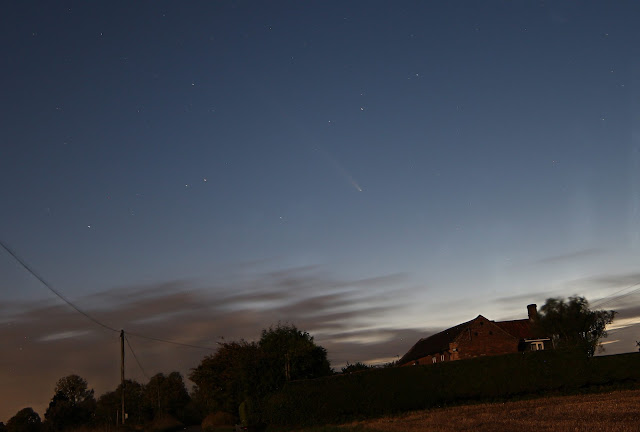
Comet Tsuchinshan-ATLAS, C/2023 A3 , Comet A3,
A cosmic wanderer, Comet Tsuchinshan-Atlas or more commonly known as Comet A3 has traced its elliptical path through the solar system, a j...
-
ASTRONOMER: When you rearrange the letters: MOON STARER Does anyone know any more that are astro related??
-
An 85% waxing gibbous moon phase is certainly a distraction for astrophotographers looking for faint fuzzies. But what can we do (launch a ...