Sunday, 13 August 2023

M13 The Great Cluster

Without doubt the finest of globular clusters visible in the northern hemisphere. Located outside the plane of our galaxy and some 25,000 light years away.

An easy target to find.

M13 is located in the constellation Hercules, between summertime’s two brightest stars, Vega and Arcturus. About 1/3 of the way from Vega to Arcturus, locate the four modestly bright stars forming the Keystone of Hercules. On the Arcturus side of the Keystone, M13 lies between the stars Eta Herculis and Zeta Herculis.

A typical binocular field is about 5 to 7 degrees in diameter, and the Hercules cluster is found about 2.5 degrees south of Eta Herculis. The Hercules cluster’s position is Right Ascension: 16h 41.7m; Declination: 36 degrees 28′ north.

M13 was one of my first targets I captured many years ago. The cluster will not have changed since it's discovery over 300 years ago,  but my imaging and processing have. This Image is just 1.5 hours of data using the ZWO RGB filters, 30 minutes per filter.


Cropped image


Processed in Pixinsight.

Wednesday, 2 August 2023

Elephants Trunk Nebula

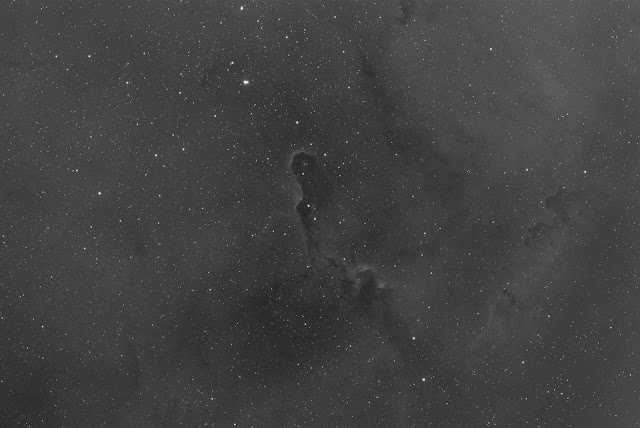
So it is a school night but while the skies remain clear I will start with a couple of hours of new target data on the Elephants trunk Nebula. 3 minute subs using the Optolong narrowband filters starting with Ha. A great night of data capture using the ASI air pro I managed to capture 71 x 180 second exposures resulting in just over three and a half hours. As normal a 3 minute stretched sub is noisy but with a promising amount of data.

No processing here other than a histogram stretch.

WBPP is an incredible script that combines all the sub frames with calibration frames and does an amazing job. This is the combined efforts of those 71 frames. I have also included the starless image.


I am posting these about a month after processing, it would appear there is a brightness difference between the two. 

Update Aug 2nd. The weather has been awful for the whole of the UK and I have not completed any further progress on this project. If this keeps weather keeps up I will crack on and finish it next spring..... Further updates to follow.


Wednesday, 26 July 2023

M92

 M92 is considered to be one of the oldest globular clusters in the Milky Way with it's 300,000 stars forming over between 12 & 13 billion years ago. The entire cluster is 100 light years wide and any planet orbiting one of those stars would live in perpetual daylight, never knowing the larger universe that exists beyond.


Monday, 12 June 2023

Cygnus Wall

The light June nights can be a very difficult time to image deep sky objects, if the moon doesn't interfere then the lack of darkness here at 52 degrees is just as bad. A few years ago I imaged the NGC7000 region in a mosaic capturing both the North America Nebula and the Pelican as well. This time would be a little different with more focal length I knew the Cygnus wall would frame up quite nicely. Over a period of 4 nights I have managed to capture around nine hours of data using the ha and Oiii filters in the hope to produce a HOO image.

I will be capturing data using my Optolong narrowband filters inside the Zwo 36mm filter wheel.

The Cygnus wall is a small part of the overall North America Nebula, The nebula is an emission type intermixed with a wall of dust, the final region covers a huge 70 light years.

My rig like most are under sampled using 3.76 micron pixels on the 130mm refractor so when processing I use a 2 drizzle integration. The downside to this was leaving it overnight to process the data in WBPP

Single 180 second Ha frame


113 x 180 seconds combined master. ABE, Blur X, & Noise X applied

Single 180 second Oiii


83 x 180 seconds combined master. ABE, Blur X, & Noise X applied


I used a pixel Maths expression to combine the 2 frames


Lets go Starless


 Red & Blue masks created to tease out some additional colour, plenty of contrast added added some Convolution to blur the colour data. I duplicated the Ha master giving some high contrast and some serious deconvolution adding sharpness and added to the near completed image. Finally I added the star back in.


I am very pleased with the final result. What do you guys think?


Wednesday, 31 May 2023

Hickson 44

I have long known about the ARP (The Atlas of peculiar Galaxies) but not known a great deal about the Hickson group of galaxies. 

I was playing with Stellarium looking for a new group of galaxies in Leo when I by chance found the Hickson 44 group. As always I do a google search and check out what the group looks like and found the group to be really interesting. 

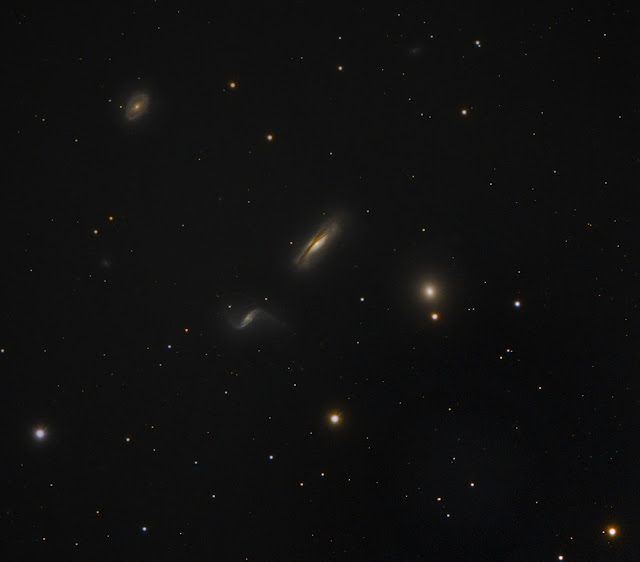
The Hickson 44, after Canadian astronomer Paul Hickson, is a group of gravitational bound four galaxies about 100 million light-years away in constellation Leo. Other names include the Leo Quartet and the NGC 3190 Series. The two spiral galaxies in the center of the cropped image are edge-on NGC 3190 with its distinctive dust lanes, and S-shaped NGC 3187. The bright elliptical galaxy lower right is NGC 3193 the spiral in the center lower portion is NGC 3185.

Just 12 x 3 minutes per RGB filters used here, so a little over and hour and a half in total. Very pleased with the result and definitely worth a deeper view next spring.


Tuesday, 30 May 2023

Moon May 24, 26th & 28th


Taken over 6 nights 24th, 26th & 28th May. What a difference a few days make.

All taken with the 130 EDT and using the 2600mm. Not a planetary cam especially at 6 frames per second. A 2 panel mosaic for each image and an AVI run of 5minutes, Best 65% using Auto stakkert and Registax 6.


Monday, 29 May 2023

Pillars of creation

Holy smokes, sometimes you just need to stop in your tracks and just behold the beauty, majesty and enormity of space. M16, The Eagle Nebula or more commonly known as "The Pillars of Creation" is probably the most iconic and well known images of deep space and the legacy of the Hubble space telescope. First captured by Hubble back in 1995. The "Pillars of Creation" is a star forming cloud of Hydrogen gas 90 trillion kilometers wide. The tiny section in the centre of my image resemble fingers, stalagmites of condensing clouds of Hydrogen gas and dust forever reaching into the darkness, lying deep within and not visible to conventional cameras are eggs or incubators of newly formed stars ready for birth in a few hundred million years.

The Black & White images here are my own from my 130mm telescope and cooled camera capturing light at the frequency of 656.21nm or the wavelength Hydrogen Alpha.


An ever increasing zoom into my image reveals the Pillars in all their glory. 
Seven hours of data capture this incredible region.


Finally I get to compare my image to the most celebrated of Hubble's images. With Hubble's final cost of around $10 billion and my modest set up around a million times less I don't think I have done a bad job.


NASA, ESA, and the Hubble Heritage Team (STScI/AURA) - http://hubblesite.org/image/3471/news_release/2015-01

M10

Well a first for me I think in the last couple of years. 3 yes, three nights clear in a row and no work, so that means 3.00am finishes each night. Tonight would be night 4 but the forecast is for clouds. Oh well it was good while it lasted.

The plan to continue with the E nebula when it rises high enough so for now just 45 minutes 15x 60 sec RGB on M10. It will soon disappear into the tree so very limited time on target. I have a high fence around the house and a tree at due south so anything this low that rises is only visible for an hour or so.

Not a great result but happy I managed to capture it.


Sunday, 28 May 2023

Arcturus

Arcturus

Located relatively close at 36.7 light-years from the Sun, Arcturus is a red giant of spectral type K1.5III—an aging star around 7.1 billion years old. Arcturus has moved from it’s Hydrogen to Helium burning to Helium to Carbon phase. The star cools and changes colour to more orange & red, as it cools it expands and sheds the outer layers.

It is about the same mass as the Sun, but has expanded to 25 times its size and is around 170 times as luminous. Its diameter is 35 million kilometers.


Size comparison.

Image credit: Daniel William "Danny" Wilson - Own work, CC BY-SA 4.0, https://commons.wikimedia.org/w/index.php?curid=124244874


Tuesday, 23 May 2023

M12


Not a great deal has changed in the 259 years since its discovery by French astronomer Charles Messier, M12 is a densely packed cluster of hundreds of thousands of the galaxies very oldest stars estimated to be over 13 billion years old, bound by gravity this cluster is 75 light years in diameter or about 435 trillion miles in length in comparison that would be approx. 74,000 yes seventy four thousand times the size of our own solar system of planets.

It took the new horizons probe 9.5 years to get to Pluto so that would mean it would take another seven hundred thousand years before it arrives at the majestic M12.

This image is an RGB combination of 20 x 120 second exposures using all 3 filters so a total of 2 hours combined data, processed in PI.

Considering this for me is very low down and just above the fence line I am very pleased with the result.


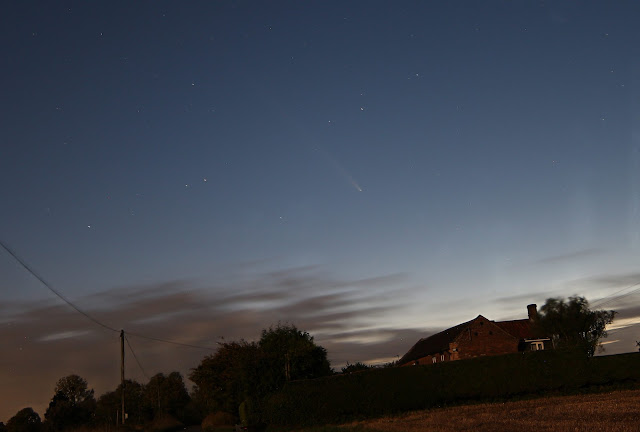
Comet Tsuchinshan-ATLAS, C/2023 A3 , Comet A3,

  A cosmic wanderer, Comet Tsuchinshan-Atlas or more commonly known as Comet A3 has traced its elliptical path through the solar system, a j...