The Great Orion Nebula has always been a firm favourite to view visually or to image. I was lucky enough to view the trapezium through the clubs 20 reflector. A beautiful sight in a quality eyepiece. I also had some fun imaging it too. Not a very favorably placed object for my backyard with the fence and a number of electricity cables stretching across from The South to the North East. So an imaging run consist of a lot of rejected frames with wires.
Friday, 20 January 2023
M42 The Great Orion Nebula
Monday, 16 January 2023
The Horsehead Nebula
Barnard 33, also known as the Horsehead Nebula, is a dark nebula in Orion’s constellation. The dark nebula, which forms the horsehead’s shape, is illuminated by the bright emission nebula IC 434.
The Horsehead was first discovered in 1888 by Scottish astronomer Williamina Fleming. It is one of their most recognizable objects and is 1,374 light-years away from us.
The horse head’s dark area is caused by thick dust blocking the stars’ light behind it. There are other interesting targets near the Horse Head like NGC 2024 (The Flame Nebula) and a blue reflection nebula NGC 2023. The Flame Nebula is below Alnitak, which is the first star on Orion’s Belt. At a magnitude of 1.77, it is the brightest star in this image.
The constellation of Orion has several large stellar nurseries. The Horsehead and Flame Nebula are part of the Orion Molecular Cloud Complex, a star-forming region.
The Flame Nebula has a cluster of several hundred newborn stars at its center. The Flame Nebula is a magnitude 10 and about 1350 light-years away.
Saturday, 7 January 2023
Melotte 15
The full moon interferes with imaging the very faint objects so I have been reprocessing some data captured from early last year. These two images lie within the centre of the Heart Nebula. The first is Melotte-15 is the star cluster at the heart of the Heart Nebula. It is an association of very young hot blue supergiant stars that are only 1.5 million years old. Fierce stellar winds from this cluster have blown the enormous bubble within the parent nebula that is the heart nebula. Image 2. The winds have sculpted the dust clouds within which other stars are forming into interesting columns and shapes.
Monday, 2 January 2023
Shiney bright thing
My scope is only 550mm focal length so not designed for lunar imaging. Also my camera is not a planetary camera imaging at just 6 frames a second. So no chance really of capturing good seeing. So the next 3 images are captured with the ASIAir pro. AVI processed in the software and the final jpegs are not huge in size.
Sunday, 1 January 2023
The Tadpoles SHO processed
About 9 hours of data used to create the HSO version of the IC 410 nebula.
This was a project started lst year with just some Ha data.
Friday, 30 December 2022
Spider Nebula
I have a few targets in the constellation of Auriga that I continue to look at capturing, some of which were captured last winter, seems like a long time since I captured IC405 & 410 now, I should have a re process using what I have learnt over this last year from Pixinsight...But as for last night I managed 3hrs 50 mins of Ha data on IC417 the Spider Nebula. I plan on an SHO image using 5 hours from each filter. As a start we have here an ASI air quick stack and screen stretch of the ha data. Looks lovely on the tablet but just a little processing via Pixinsight I have some lovely clean data and some lovely details too.
IC 417 just left of centre of the image (also known as Sh2-234) is an emission nebula of almost 100 light-years across, located some 10,000 light-years away from Earth in the constellation of Auriga (the Charioteer). It is often referred to as the Spider Nebula and in that case its prey is a nearby (above) emission nebula called the Fly (NGC 1931).The nebula contains a young open cluster of about 40 stars, and is energized by its hot, massive blue stars which are still embedded in glowing hydrogen gas.
In the bottom right hand corner is the Charles Messier famed M38 open cluster a much closer 3480 light years and to it's left NGC1912 starfish cluster.
3. Starless
There will be a great deal more to add to this post as time moves into 2023, there will be at least 5 hours of Ha, Oiii & Sii data to create a SHO palette image.
Malcolm. aka The Astrogeek
Saturday, 24 December 2022
Horsehead Nebula
I would like to say the year would not be complete without an image of the beautiful Horsehead Nebula. This is one object that I just wish was half it's 1375 light years distance from us. It would truly be a spectacular sight filling the winter sky. I am hoping for some more clear sky to complete the HAGB project. So far we have 16 x 5 minute sub frames.
I am so incredibly pleased with my set up, a few people recently have posted issues with the ZWO EAF and I can honestly say thankfully I have had no issues with it achieving nothing short of perfect focus 100% of the time. So I thought I would do a serious crop of the horsehead and yes the Blur exterminator plugin has been run. It will certainly be after Christmas now for the remainder of the data for a HaGB colour image, Ha data looks great so far for 1 hour 20 minutes.
Thursday, 22 December 2022
M45
One the most recognisable objects in the night sky is the
Pleidies or the 7 sisters. In Greek mythology they were the 7 daughters of the
Titan Atlas & and his wife Pleione. Legend says with the weight of the
world on Atlas’s shoulders he was unable to protect his daughters from the great
hunter Orion, so In order to save them Zeus transformed them into stars placed
them in the heavens away from Orion’s reach.
In reality the cluster contains more than three thousand young hot stars all formed within the last 100 million years with only the brightest visible to the naked eye. The blue nebula that is visible is a cloud of dust these cosmic wanderers are just passing through. My image here was captured over several recent clear nights and is a total of just over 3 hours through my telescope.
20 x 3 minute exposures for each Red, Green & Blue ZWO filters, processed in Pixinsight using the new Blur Exterminator plug in.
The Merope Nebula is the brightest
reflection nebula in the Pleiades cluster.
It is also known as Tempel’s Nebula. It was discovered by the German astronomer
Wilhelm Tempel from Venice, Italy on October 19, 1859. Tempel used a 4-inch
refractor to observe the famous open cluster.
Tuesday, 20 December 2022
The Jellyfish Nebula
30,000 years ago, our planet was in the grip of our last ice age, about the same time Neanderthals were painting the earliest images found in the caves of India. Above early man’s head in the night sky a super massive star has succumbed to the forces of gravity and collapses in on itself, the resulting supernova outshines every other star in the heavens. As we fast forward the thousands of years what we see now is the ever-expanding cloud of dust and gas resembling a jellyfish forever swimming in the cold inky black ocean. Imaged over the last two cold clear nights, nearly nine hours of data were needed to capture this cosmic Scyphozoa.
At the time of posting there has been a new Pixinsight plugin that is creating a great deal of attention by the incredible Russell Crowman. The Blur Xterminator plug in. So there will be an update shortly incorporating this into my workflow.
An except from Russel's Website. BlurXTerminator (rc-astro.com)
BlurXTerminator is an AI-based deconvolution tool designed specifically for astronomical images taken with equipment commonly used by amateur astrophotographers. It is available as a process module plug-in for PixInsight only.
Not all AI is created equal. AI-based sharpening tools for general photography exist but, when applied to astronomical images, they are prone to "inventing" detail that does not exist. They also don't usually handle stars very well. Their neural networks were not trained on astronomical images, so they often make bad "guesses" as to what the original, unblurred scene looks like.
The design intent of BlurXTerminator is to recover as much detail as possible based on low-contrast information actually present in an image, without fabricating detail that does not in fact exist just for the sake of an image that appears sharper. Great care has been taken in the architecture and training of the neural network to ensure that its output is as faithful as possible to reality if it is properly used.
Sunday, 18 December 2022
Saturday, 12 November 2022
Sadr in Ha
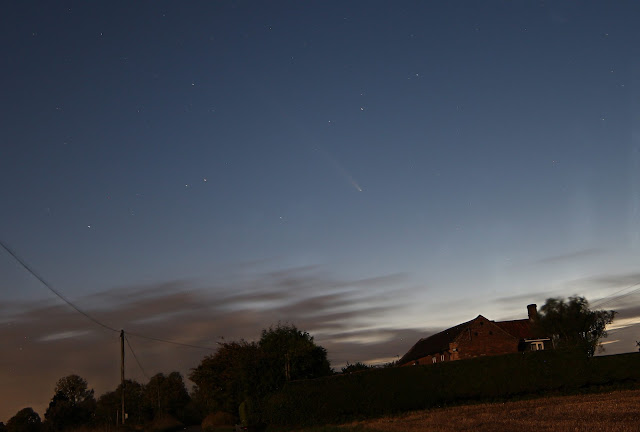
Comet Tsuchinshan-ATLAS, C/2023 A3 , Comet A3,
A cosmic wanderer, Comet Tsuchinshan-Atlas or more commonly known as Comet A3 has traced its elliptical path through the solar system, a j...
-
ASTRONOMER: When you rearrange the letters: MOON STARER Does anyone know any more that are astro related??
-
A cosmic wanderer, Comet Tsuchinshan-Atlas or more commonly known as Comet A3 has traced its elliptical path through the solar system, a j...