Well everything is all set up again in the observatory and despite a near full moon when taken everything is working well.


A few small tweaks on the aggression settings and guiding numbers are down to a really impressive set of low numbers.
A few small tweaks on the aggression settings and guiding numbers are down to a really impressive set of low numbers.
A little maintenance is required for the observatory, the roof has been sticking a bit lately and I have also wanted to connect the wifi switch module to control the dome movement from inside the house. After all I have had had it a few months now and just never got around to figuring it out.
Observatory Dome Automation.
The holy grail for this seasoned and now somewhat lazy
astronomer is total automation in the imaging process. Long gone are the days
of lugging the heavy mount from the shed, desperately avoiding the cat and
power cables as you carry the scope across the lawn. On bended knee with one
eye open trying to figure out the hour angle of Polaris, balancing, connecting,
aligning everything to no avail as the clouds roll in.
151a is now my forth observatory build and the most
challenging.

 Atop of my
observatory I have a 6ft fiberglass dome manufactured
Atop of my
observatory I have a 6ft fiberglass dome manufacturedI follow quite a few Youtube channels following
astronomers as they battle their own journey of learning and improving in their
hobby. One in particular is “Astrobloke” an astronomer who’s interest is
creating a fully automated imaging set up with his roll on / off roof
observatory. Over a few months he eluded to a the possibility of controlling
his roof by the means of a app using a simple wireless relay. A simple and
cheap little box purchased from Amazon for currently £26.
A few months
passed and convinced myself I could not make this work as the internal wiring
of the power supply looked just a mass of wires and struggled with getting my
head around what was what at what wire went where. So I stripped it all back
and rewired sending a supply to the module and outputs to each motor.


I downloaded an App EweLink and paired via the wifi and pushed the button…It works. After adjusting a few settings the dome moves by itself for 3 seconds whenever it’s needed to move. The next step is to automate this with a programme like Nina or SGP. Astrobloke now says he has developed with another youtuber some open source software that does indeed work via Nina so it is now truly intergrated into his imaging process. This is something I will certainly like to look at but for now I am happy and content with pushing a button every 30 minutes,
The next and final part of the project will be dome
shutter control open and close but for now no more getting up, going outside,
no more accidental triggering of the neighbours lights, Lazy or what..


I would say I have been electronic imaging since 2005 with my first Canon camera that was
purchased in
2005 Canon 300d a 6.3mp.


2014 Starlight Express Sxvm25

2019 Zwo ASO 294Mc Pro

2021 ZWO ASI1600mm

A restart to the project of Simies 147, the previous below 4 pane mosaic was captured using data from the fantastic Telescopius website. It suggested that the 4 panes would work and stich together, as you can see further down that didn't work. So I have re planned a 6 pane mosaic with a greater 30% overlap. I ran a test with 2 frames and with a stretch and alignment in Photoshop and Bingo it works. I would like to run with more data looking at 4-5 hours on each frame, more data equals more signal and less noise. So below is the first run of 50 minutes data per frame. So far with so little data I am very pleased that there is the full shell on view. Shown in negative here you can see the joins and the noise is very apparent. Very happy so far.

New project time. I have never attempted this object before even with widefield DSLR. Simeis 147, also known as the Spaghetti Nebula, or Sharpless 2-240, is a supernova remnant (SNR) in the Milky Way, so huge it straddles the border between the constellations Auriga and Taurus. Discovered in 1952 at the Crimean Astrophysical Observatory by Grigory Shajn and his team using a Schmidt camera and a narrowband filter that was close to the Hydrogen Alpha transmission line. It is difficult to observe due to its extremely low brightness. I honestly was not sure if I would be able to capture anything using 300 second exposures. My first attempt was a 4 pane mosaic using Telescopius to copy the CSV file and pasting it into the ASI air pro. As you can see things did not quite align with a 15% overlap.


My second go will be a 6 pane with a 30% overlap
The Monkey Head Nebula is a star-forming region located 6,400 lightyears away in the Orion constellation.
NGC 2174, to give it is formal name, is a place where new stars are being born at a fierce and rapid rate, and these newly born stars emit powerful streams of charged particles known as stellar winds that blow the gas and dust away, removing the ingredients necessary for future stars to be born.
Dark dust streams among the glowing cosmic cloud to give the nebula its ape-like appearance.
The Monkey Head Nebula is an emission nebula, which means it is a cloud of gas that emits its own light. This is as opposed to a reflection nebula in which hot stars cause surrounding gas to glow.
It is associated with open star cluster NGC 2175 and can be found in the can be found in the Orion constellation.
We have below the Ha, S2 & Oiii frames of 1Hr 30 Mins each.


An 85% waxing gibbous moon phase is certainly a distraction for astrophotographers looking for faint fuzzies. But what can we do (launch a virgin rocket at it).. Thank goodness for the Ha filter, Because of the brightness of the sky background I reduced the exposure time to two minute subs and captured 4 hours worth of data. Imaging with the incredible ZWO ASI 2600MM and the 36mm filter wheel. I invested also in a set of Optolong narrowband filters. I was incredibly impressed with the L- Enhance and it's ability to keep halo's and star sizes to a minimum. So for me it was a no brainer to add these to the arsenal. Saying that their LRGB filter set were new and untested at the time of purchase so I opted for the ZWO filter set. I am happy with them so far. But as I said the Ha filter was deployed last night and with a image stretch and dark dust enhancement I have a really clean image. Desperate for for some Oiii & Sii now.
Right so update alert last night was a clear night so had the opportunity to shoot 2 hours each on Oiii & Sii.
Processed on my new laptop and wow it is fast.
Registered aligned & stacked in Deep Sky Stacker.
Starnet++
Processed in photoshop with
HSO colour mapped & selective colour
Levels & Curves
Photokemi astro tools Space dust & Dark details medium
Topaz denoise.
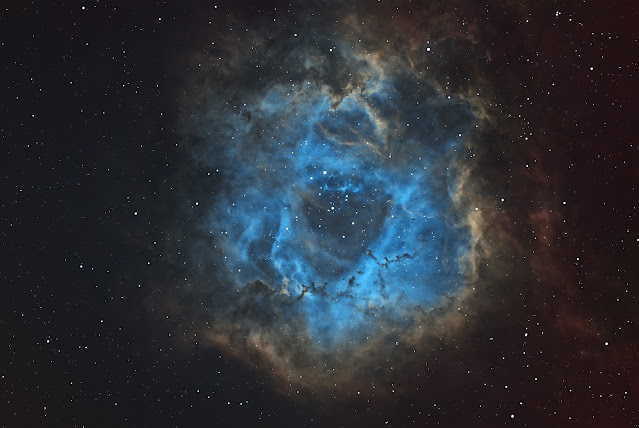

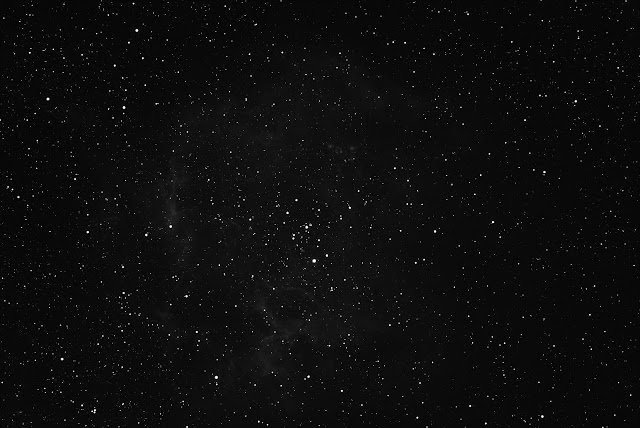
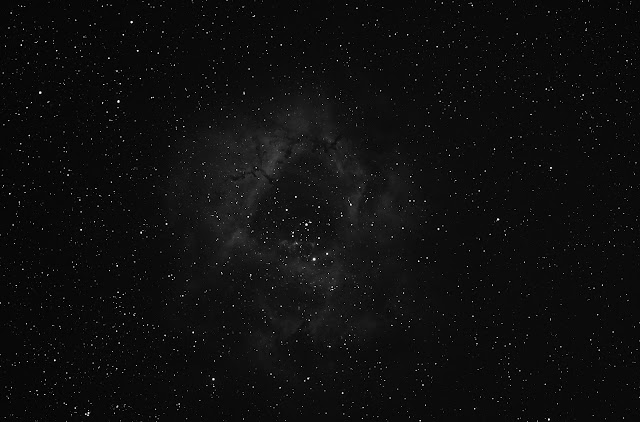

Photo Details
Ok so lets talk about distance particularly the speed light.
In a vacuum, we know that light travels at 670,616,629 mph. So If a little context is needed light from the moon takes 1.3 seconds to arrive at our eyes, Saturn is 1.3 light hours away a measly 0.0001505453985955772 light years distant. So what is a light year?
quite simply the distance light travels in a year 5,878,625,370,000 that's nearly 5.9 Trillion miles. Ok so back to the point I wanted to make IC434 or the Horsehead nebula is an immense cloud of thick dust obscuring star birth inside it and in galactic terms the Horsehead is an insignificant 3.5 light years in diameter but when you compare that against our solar system and our distance to Saturn it would be a huge two hundred and twenty one thousand three hundred and forty four (221,344) times the distance.
If you ever needed reminding SPACE IS BIG.
My image was captured 2 nights ago at my home observatory with about 4 hours of data. Over the years I have taken many images of this target and I was lucky enough back in April of 2015 to appear in an episode of the Sky at night celebrating Hubble's 25 year Anniversary. One ticked off my bucket list anyway.


My new laptop has amazing processing power, attempted several times previously to process a starnet++ starless image, it failed several times, introduce Mr Dell and it processes a colour starless image in less than 2 minutes, a chunk of star reduction and hey presto a lovely update to mt=y first process.


Unchanged for eons. The Pleiades or the 7 sisters look the same today as they did for the first humans that walked the earth 1.9 million years ago. Without doubt the most beautiful and most recognisable of all the objects we can see in the night sky, this cluster of stars shine and reflects a hypnotic blue light onto dust that the stars are passing through. There is even a bronze age 1600bc artifact called the Nebra sky disk that is believed to depict the cluster. Located at a distance of around 400 light years. This means the light we see today left at the time Galileo Galilei made his first observations with the first telescope.


Galileo's drawings of the Pleiades
star cluster from Sidereus Nuncius. Image courtesy of the History of Science Collections,
University of Oklahoma Libraries.
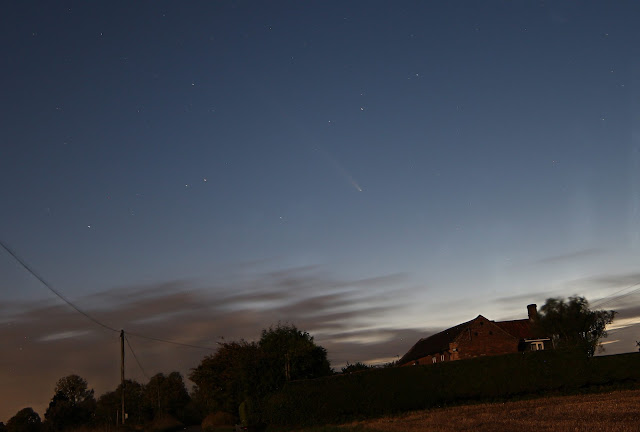
A cosmic wanderer, Comet Tsuchinshan-Atlas or more commonly known as Comet A3 has traced its elliptical path through the solar system, a j...