 My imaging set up is not designed for planetary imaging. But I couldnt resist having a go at the true king of the planets Jupiter. Taken with my 90mm refractor with the DSLR attatched to a 2 x barlow using 5 x live view magnification and video recording a stack of 500 frames aligned and stacked in registax. Wavelet sharpening and thats it. By no means an image of quality compared to some of the dedicated planetary imagers out there. I might have a go with our societies planetary imager on the 20". I will post the resulting image when it happens.
Saturday, 20 October 2012
By Jove
My imaging set up is not designed for planetary imaging. But I couldnt resist having a go at the true king of the planets Jupiter. Taken with my 90mm refractor with the DSLR attatched to a 2 x barlow using 5 x live view magnification and video recording a stack of 500 frames aligned and stacked in registax. Wavelet sharpening and thats it. By no means an image of quality compared to some of the dedicated planetary imagers out there. I might have a go with our societies planetary imager on the 20". I will post the resulting image when it happens.

Wednesday, 17 October 2012
California nebula
As promised I have had another go at the huge NGC1499. I sometimes wonder how something as huge as this never made the messier catalogue.
I have managed and hour and a half this time and think I have a much smoother result.
 45 x 2 minute guided exposures at ISO 1600. No darks , flats or bias frames added , subtracted or divided. I just love the new JMI focusser. so simple and quick to auto focus. I have had a long day at work today. Just can't think of anything else to add. Goodnight all....
I have managed and hour and a half this time and think I have a much smoother result.
 45 x 2 minute guided exposures at ISO 1600. No darks , flats or bias frames added , subtracted or divided. I just love the new JMI focusser. so simple and quick to auto focus. I have had a long day at work today. Just can't think of anything else to add. Goodnight all....
Saturday, 13 October 2012
CHIPS
I am sure many people will remember the American tv programme CHIPS. Based on the Californian highway patrol motorcycle cops. Well I thought it was a good title for a post ha ha!!
Having spent most of the session imaging the wonderful Comet Hergenrother. I wanted to just have my first go at the huge California nebula NGC 1499 before closing up.

This image is very noisy as only 22 minutes were captured at ISO 1600. My 40D is unmodded so I was pleasantly surprised with the amount of red light captured. Also worth a session with the UHC filter too. A target with good altitude for UK observers so I will definately revisit with some long exposure. Keep looking for the latest pics. I cant wait to see a difference. I was so pleased last year when I images the horsehead for the first time. A very smooth image with some fine detail was the result. shortcut to it here https://blogger.googleusercontent.com/img/b/R29vZ2xl/AVvXsEj5yUWG_b1MxqxKDpW1QfgK_NzPd_lrb4CaWiP1EfBa5ZZtaZeviBYKpWyLSVKw7iQYsQxIasCqc2FXrTZ6BsGgUveIJPOeBUciUfAI7PRGSUcWhsEgWVfbKdhMmTa1KpEn1gFWagxKv0Q/s1600/flame+horse+weirdcropped.jpg
Having spent most of the session imaging the wonderful Comet Hergenrother. I wanted to just have my first go at the huge California nebula NGC 1499 before closing up.

This image is very noisy as only 22 minutes were captured at ISO 1600. My 40D is unmodded so I was pleasantly surprised with the amount of red light captured. Also worth a session with the UHC filter too. A target with good altitude for UK observers so I will definately revisit with some long exposure. Keep looking for the latest pics. I cant wait to see a difference. I was so pleased last year when I images the horsehead for the first time. A very smooth image with some fine detail was the result. shortcut to it here https://blogger.googleusercontent.com/img/b/R29vZ2xl/AVvXsEj5yUWG_b1MxqxKDpW1QfgK_NzPd_lrb4CaWiP1EfBa5ZZtaZeviBYKpWyLSVKw7iQYsQxIasCqc2FXrTZ6BsGgUveIJPOeBUciUfAI7PRGSUcWhsEgWVfbKdhMmTa1KpEn1gFWagxKv0Q/s1600/flame+horse+weirdcropped.jpg

Comet 168P/ Hergenrother
This is my Animation of 60 x 1 minute frames.

Monday, 1 October 2012
A billion Stars
Been a little busy recently, Going on holiday, Back to work, A set of nights, Sending eldest daughter to University, all plays havoc with the astronomy. I have been playing a bit with Maxim DL. I am trying to use the auto focus setup procedure and combine automation with exposure control. I still have a slight DEC drift and need to re centre the image by a few arc seconds every other exposure. So just trying to get everything sorted out. Andromeda was at a nice elevation so I thought I would have a little test.
 This shot 2 Hour 13 Minute exposure in 3 & 5 minute subs. No dark frame subtraction, Flats or bias taken. Iso 1600. Canon 40D through my imaging set up. Comparing it to the others I have taken I think it is the best hands down. I would appreciate any feedback too!
My own criticism is that if I had taken a few short exposures I could tease out a little more detail in the core. Easily remedied as maxim has saved the camera rotation angel when I plate solved the image. So another visit sometime soon I hope. I might consider sending it to sky at night mag too.

My own criticism is that if I had taken a few short exposures I could tease out a little more detail in the core. Easily remedied as maxim has saved the camera rotation angel when I plate solved the image. So another visit sometime soon I hope. I might consider sending it to sky at night mag too.
Thursday, 23 August 2012
M103
 M103 (Ngc581) is one of the more remote open clusters in Messier's catalog, at about
8,000 light years distant in one of the most recognised constellations of Cassiopeia the queen. Visible in my binoculars against a rich star field it was the last entry to his original catalogue without him actually observing it. Well Mr Messier I have seen it. and I have ticked it off my list. The bright star also visible at the top is Ruchbah or(δ) Delta Cassiopeiae Cassiopeiae. See finder chart. To me this star is a little more interesting than the cluster. It is an eclipsing binary star system consisting of a pair of stars that orbit about each other over a period of 759 days.
M103 (Ngc581) is one of the more remote open clusters in Messier's catalog, at about
8,000 light years distant in one of the most recognised constellations of Cassiopeia the queen. Visible in my binoculars against a rich star field it was the last entry to his original catalogue without him actually observing it. Well Mr Messier I have seen it. and I have ticked it off my list. The bright star also visible at the top is Ruchbah or(δ) Delta Cassiopeiae Cassiopeiae. See finder chart. To me this star is a little more interesting than the cluster. It is an eclipsing binary star system consisting of a pair of stars that orbit about each other over a period of 759 days.
The primary a white sub giant has a stellar classification of A5III-IV, with the luminosity class of IV indicating that it has exhausted the hydrogen at its core and has begun to evolve through the subgiant phase into a giant star. It has expanded to about 3.9 times the Sun's radius. It is moving through the Galaxy at a speed of 43.9 km/s relative to the Sun.
M39
The last week has been a little traumatic for the whole family, Our eldest daughter has been waiting to find out if she has the grades to get into Uni. A sigh of relief as she is awarded her primary place at Anglia Ruskin. Congratulations Jasmine. The Younger two have been driving us nuts as they are desperate to go on their sunny holiday and bored of being at home from school.
The RA drive on the mount was very tight and needed a strip down and rebuild, All went well until I ran a test on the guiding. What could be the matter here. PHD would not keep the guide star for more than a few seconds. Lets not panic yet I thought so I ran 60 x 30 second test shots. A nightmare. The subject has moved over a degree across the field of view. The only thing I could think of was the polar alignment. I do my polar alignment using the Kochab clock method. Always worked well for me!! As I looked through the finder the illuminated cross moved, damn, the whole finder had been knocked at some point and almost fell out the holder. Not a great deal more I can do tonight. Next day allowed to me to strip it all down and rebuild and align the polar finder. A chimney pot half a mile up the road stayed where it should be as the pole finder was tightened into position.
A new test on Scheat in Andromeda was perfect. 2 minutes, 5 minutes, 10 minutes was no issue at all.
 M39 was the target of choice nearly above my head so I ran 30 x 2 minute guided exposures at 1600 ISO. Processed in Maxim DL & Photoshop.
The RA drive on the mount was very tight and needed a strip down and rebuild, All went well until I ran a test on the guiding. What could be the matter here. PHD would not keep the guide star for more than a few seconds. Lets not panic yet I thought so I ran 60 x 30 second test shots. A nightmare. The subject has moved over a degree across the field of view. The only thing I could think of was the polar alignment. I do my polar alignment using the Kochab clock method. Always worked well for me!! As I looked through the finder the illuminated cross moved, damn, the whole finder had been knocked at some point and almost fell out the holder. Not a great deal more I can do tonight. Next day allowed to me to strip it all down and rebuild and align the polar finder. A chimney pot half a mile up the road stayed where it should be as the pole finder was tightened into position.
A new test on Scheat in Andromeda was perfect. 2 minutes, 5 minutes, 10 minutes was no issue at all.

Thursday, 2 August 2012
A new View of Altair

Friday, 27 July 2012
The Western Veil NGC 6960
I have just had a thought as I sit here typing. How about bringing one of the names of the veil upto modern day times. Known as the witches broom. I will change it to Harry's Nimbus 3000. Good old Harry Potter.
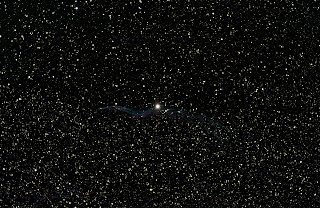
Not having a modified Canon I have limited sensitivity to the faint nebulosity that the western Veil displays. A revisit for sure with the UHC filter attatched. Last night was certainly the poorest night of the last 4 with a high dew point moisture was dripping from the outside of the dome.
Iso 1600 with 58 minutes of data has at least captured the wave like shape behind the naked eye star 52 Cygni.

Not having a modified Canon I have limited sensitivity to the faint nebulosity that the western Veil displays. A revisit for sure with the UHC filter attatched. Last night was certainly the poorest night of the last 4 with a high dew point moisture was dripping from the outside of the dome.
Iso 1600 with 58 minutes of data has at least captured the wave like shape behind the naked eye star 52 Cygni.
Thursday, 26 July 2012
M15 and a new toy.
 Last nights clear night saw the first test of my new Auto focus system from JMI and HiTech Astro from the very speedy and efficient Rother Valley Optics I called them Weds am and was promised a call back as they were busy completing an order. As promised they called back and was offered excellent advice saving me £70. A promise was made for delivery tomorrow. I have to admit I was holding back a laugh when he said it. Sure enough to his word it arrived the following day via courier. Set up was simple the motor just fits between the locking screw for the focusser and a hood onto the 10-1 focus knob. The control box was pre wired with a cigarette socket plug, lucky for me my now redundant dew system used the same connector and a power supply was hooked up. I downloaded the ASCOM drivers and it was recognised by the laptop instantly. I use both Imagesplus and Maxim for image acquisition and connection to the 2 programmes was simple.
 ISo 800 and 1 hour of exposures has captured stars to the core. Maxim DL is now the prefferred programme for stacking. A small DDP stretch and a pretty star spike later has landed me a wonderful result.
http://www.hitecastro.co.uk/
http://www.rothervalleyoptics.co.uk/productsd.php?search=jmi&x=0&y=0
M2
 M2 (NGC7089) is one of the largest globular clusters consisting of approximately 150,000 stars
located within our galaxy at a distance of approximately 36,000 light years.
Estimated to
be 13 billion years old, almost as old as time itself. A lovely view at high power resolve the cluster into a swarm of bees. Even with my Megrez 90 I am pleased to resolve nearly all the way to what is a very dense core. Once again Iso 800 works well with the clusters and an hour of 2 minute guided exposures. A fantastic well illuminated wide field has not required a need for flats here.
M2 (NGC7089) is one of the largest globular clusters consisting of approximately 150,000 stars
located within our galaxy at a distance of approximately 36,000 light years.
Estimated to
be 13 billion years old, almost as old as time itself. A lovely view at high power resolve the cluster into a swarm of bees. Even with my Megrez 90 I am pleased to resolve nearly all the way to what is a very dense core. Once again Iso 800 works well with the clusters and an hour of 2 minute guided exposures. A fantastic well illuminated wide field has not required a need for flats here.
Subscribe to:
Posts (Atom)
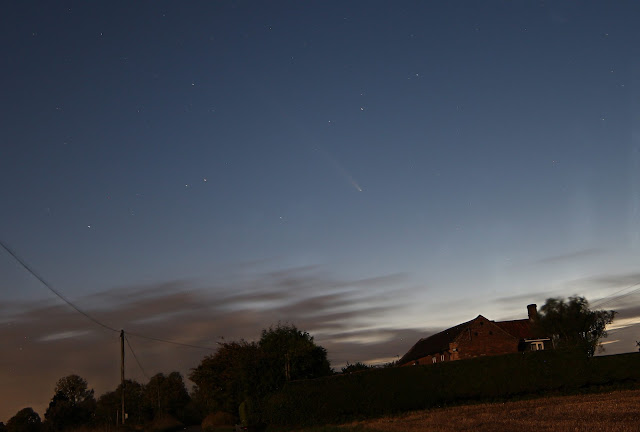
Comet Tsuchinshan-ATLAS, C/2023 A3 , Comet A3,
A cosmic wanderer, Comet Tsuchinshan-Atlas or more commonly known as Comet A3 has traced its elliptical path through the solar system, a j...
-
ASTRONOMER: When you rearrange the letters: MOON STARER Does anyone know any more that are astro related??
-
 A cosmic wanderer, Comet Tsuchinshan-Atlas or more commonly known as Comet A3 has traced its elliptical path through the solar system, a j...