Monday, 3 January 2022

M45 The Pleiades


Unchanged for eons. The Pleiades or the 7 sisters look the same today as they did for the first humans that walked the earth 1.9 million years ago. Without doubt the most beautiful and most recognisable of all the objects we can see in the night sky, this cluster of stars shine and reflects a hypnotic blue light onto dust that the stars are passing through. There is even a bronze age 1600bc artifact called the Nebra sky disk that is believed to depict the cluster. Located at a distance of around 400 light years. This means the light we see today left at the time Galileo Galilei made his first observations with the first telescope.


Nebra Sky Disk image first published Dec 2006 Copyright Dbachmann

Galileo's drawings of the Pleiades star cluster from Sidereus NunciusImage courtesy of the History of Science Collections, University of Oklahoma Libraries.

IC405


Rippling dust and gas give name to this wonderful nebula. Located very close to my previous image of IC410. The Flaming star Nebula or IC405 is a mix of emission and reflection nebula. A future colour image when the project is complete will show just what I am talking about but for now with a close to full moon this Mono image is captured using just my Optolong Ha filter. Just 2 hours 10 minutes so far of data in 5 minute sub frames shows incredible detail already.  


At the time of this update 3rd Jan there has still been no clear nights. So posting now rather than a complete image. I am sure more updates to follow.


Saturday, 11 December 2021

IC410 The Tadpoles.


As I may have mentioned before on my facebook page and even on here too the last 5 plus weeks of weather have been truly awful. However, 2 nights from Friday last week have been cold and clear but somewhat spoilt by the approaching full moon. So the filter wheel has rotated to the HA filter and the start of 2 projects IC410 & IC405 are born.

IC410 is a dusty emission nebula located in the constellation of Auriga at about 12.000 light years from Earth. It is part of a larger star forming region that also contains the Flaming Star Nebula (IC405). The gas structures in this picture are lit by the radiation from the open star cluster Ngc1893 that lies in the center of the nebula. This star cluster is about 4 million years old, but in astronomical terms it is still very young, with hot, massive stars. Just right of the star cluster two more dense structures are visible. Affectionately known as The Tadpoles these two structures are approximately 10 light years long these are similar to the famous Pillars of Creation and they are composed of dust and gas leftover from the formation of the star cluster and are very likely to give birth to more stars in the future. As can be seen in the image, these structures point away from the center of the nebula. This is because of the stellar winds and radiation pressure from the stars in NGC 1893. The really do look like they are trying to get back to the centre.


    25x 5 minute Ha subframes.

    Tadpoles crop
    Looking a little closer they really do look like tadpoles.

Lets hope for a few more hours of data to complete a Hubble Palette image.
Watch this space:

Image Details

  • Total Exposure:  2 Hours, 5 Minutes ( 25 Frames) x 5 Mins Ha (10/12/21)
  • Image Acquisition: ZWO ASIair Pro
  • Camera Settings:  ZWO ASI2600mm pro Gain 100, 0°C
  • Accessories: ZWO 7 position Filter wheel
    •                Optolong narrowand filters 
    •                ZWO broadband filters
    •                ZWO EAF
  • Calibration Frames: No Calibration
  • Stacking and Calibration: DeepSkyStacker
  • Processing: Adobe Photoshop 2020, 
  • Size: 2.26 x 1.38 deg 
  • Pixel Scale: 1.41 arcsec/pixel

Saturday, 4 December 2021

Lobster Claw Nebula

This hobby can be so frustrating, it has been weeks since I have had the observatory open. In fact it was the 28th October since the dome shutter was rolled back for some photon capture.
My intended target was Sh2-157 The Lobster Claw Nebula, where my aim was to complete my longest imaging capture 24 hours total integration time using Narrowband filters. Narrowband filters are tuned to specific wavelengths of light emitted by Hydrogen, Sulphur & Oxygen and aiming for 4-10-10 hours respectively to create a Hubble palette colour image. One dismal failure later in respect to the weather that is, has left me with what was the initial capture of 1hr of Ha and 1.5 hours of Oiii and just 36 mins of S2 on the night of the 28th.
Patiently waiting now for weeks to further and complete the project. With more rubbish weather forecast over the next week I thought I would have a quick process to see what I have. I am not disappointed with the limited data captured and I guess It will have to wait now as there are winter targets I want to image and of course Comet 2021 A1 Leonard has brightened to becoming a serious contender for comet of the year. Agggggggggggggghhhhhhhhhhhhhh so frustrating.


Photo Details

  • Total Exposure: 3 Hours, 12 Minutes (64 Frames) 20x 3Mins Ha 32x 3 mins Oiii 12x 3 mins Sii
  • Image Acquisition: ZWO ASIair Pro
  • Camera Settings: Gain 100 -10°C
  • Calibration Frames: No Calibration
  • Stacking and Calibration: DeepSkyStacker
  • Processing: Adobe Photoshop 2020, Starnet ++ 
  • Size: 2.26 x 1.38 deg cropped to approx 60%
  • Pixel Scale: 1.41 arcsec/pixel
Additional

Guiding numbers were incredible for the session.


Wednesday, 3 November 2021

Western Veil Nebula

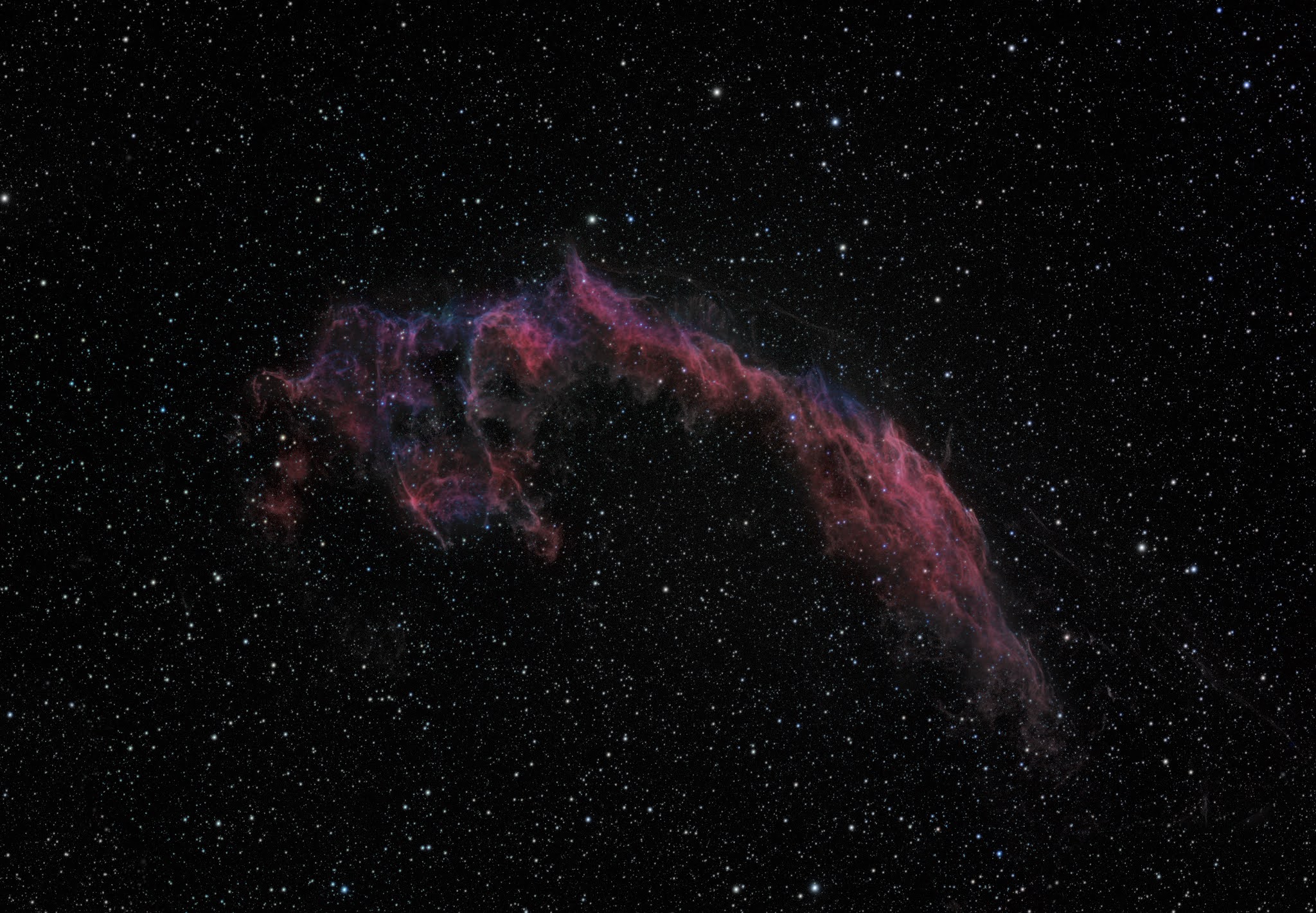
We astronomers are used to time travel, imagine if you could travel back, way back say 8000 years or so. You would have been witness to the supernova that created the Veil Nebula. A new star in that night sky would have been brighter than any other and visible for months. Fast forward to today and we see the remnant of that stellar explosion still moving at over a million miles an hour through space. This is not a true colour image but a bi colour capturing emissions of Hydrogen & Oxygen wavelengths..... This is My first Bi-colour project and a wonderful target it is too.


Photo Details

  • Total Exposure: 4 Hours, 57 Minutes (64 Frames) 30x 3Mins Ha 54x 3 mins Oiii
  • Image Acquisition: ZWO ASIair Pro
  • Calibration Frames: No Calibration
  • Stacking and Calibration: DeepSkyStacker
  • Processing: Adobe Photoshop 2020, Starnet ++ 
  • Size: 2.26 x 1.38 deg 
  • Pixel Scale: 1.41 arcsec/pixel

Aurora from Norfolk

Within minutes of an update from Aurorawatch UK, the camera and tripod were in the car and I was on the road. Well for about 3 minutes anyway arriving at my location of choice just a quarter of a mile from home looking out over fields to a reasonably dark north facing sky. I could not see anything visually as I set up the equipment but I could see the clouds coming. My first image captured was a highlight to what would come through over the next few minutes. Wonderful to see and just the second imaging capture from Norfolk in my 21 years living here. 


As soon as it came it went and disappeared quite quickly.


The last time was 27th Feb 2014 which for an hour put on a much better show.


See what I mean. Anyway looking forward to the next x class flare.


Sunday, 24 October 2021

CTB1

My most recent project is a target rarely photographed. Probably because of the low surface brightness

Supernova remnants represent the residual effects of massive stars which have reached the end of their life-cycle, including a massive stellar explosion as a grand finale, and which leave behind them spectacular gas clouds and stellar remnants) which cover vast areas in width across the sky. Regrettably, for residents of the northern hemisphere, only four supernova remnants (SNR) are visible

The Crab Nebula (M1) in Taurus,

the massive Veil complex (NGC 6960, 6974, 6979, 69926995 and Simeis 188) in Cygnus,

the Jellyfish Nebula (IC 433) in Gemini and

Simeis 147 (aka Shajn 147, Sh 2-240) also in Taurus.

The most recognized supernova remnant is perhaps the Crab nebula in Taurus which is believed to have exploded in 1054 AD as documented by Chinese astronomers of the time whereas CTB 1 and Simeis 147 are especially dim and represent some of the faintest objects in the sky.

The extended galactic supernova remnant CTB 1 in Cassiopeia is one of the closest SNR's known lying at a distance of about 9,800 light-years away. Measuring approximately 35.2 arc-minutes in diameter and physically spanning 98 light-years across, this circular formation rich with filamentary structure lies immediately east of Caph (β-Cas, mag 2.26) and is characterized with dominant opticalx-ray and radio sources. CTB 1 was originally thought to be a large planetary nebula and was included by Abell in his catalog of planetary nebula (Abell 85) but it was suggested by van den Bergh in 1960 and comfirmed by Willis & Dickel in 1971 to be, in fact, not a planetary nebula but rather a galactic SNR.


Captured also here is a plethora of Open clusters.

Ngc7790 The widows web cluster

Ngc7788

Frovlov 1

Harvard 21

King12

Berk 58


Sunday, 17 October 2021

67P/Churyumov–Gerasimenko

5 years ago now I witnessed one the most incredible feats of engineering skill man has created thus far, not happy with just dropping into orbit around Comet 67P but sending a lander onto the surface too. With gravity at 1/10000 that of earth Philae didn't quite manage to stay put when the cold gas thrusters and harpoon failed to operate. So it bounced twice and settled, wedged into the side of a hill. 


Beautiful imagery was captured and returned by the Rosetta spacecraft detailing the shape and structure. Resembling a peanut shell (image above courtesy of Rosetta) this 2 lobed comet has tumbled through the solar system for billions of years. 

I have been keeping an eye of it's location each night in the hope of a capture worthy of posting. But in typical UK weather the clouds rolled in after less than ten minutes of imaging time against the lovely backdrop of Messier 35.  My intent was an RGB image through filters and using the comet stack in DSS to keep both stars are comet a pinpoint. However plans were scuppered after 7 minutes through the red filter.


Just had a look back at my comet images and this one will be my 16th Comet imaged to date.

In no particular order we have:


All of my previous comet images can be found in the previous pages of my blog.


Thursday, 30 September 2021

M31

Almost a year ago was my M31 Globular clusters project. A fantastic project capturing a staggering 244 globular clusters associated with M31.

A year has passed and another M31 image is forthcoming. This time captured in HaRGB with my newish Mono camera, filter wheel and filters.

All of course captured with the ZWO ASI Air pro, a wonderful little device that has seen countless updated that include plan mode now. This allows an imaging run of multiple targets during a night. It allowed me on this occasion to run an imaging session on M31 swapping over filters and running the autofocus routine after each swap. It ran flawlessly.

So we have a basic stretch on each of the filters and a final combination giving a total of 4 hours, 1 hour on each filter.

Red


Green


Blue


Ha

4 hour Combination HaRGB

Crop


Overall I am very pleased with the image despite no calibration frames used at all here.


Monday, 27 September 2021

Waca Waca Waca Waca Waca Waca

Waca waca waca waca waca waca waca. Do you remember the sound of a Pacman? I bet you are doing it right now aren’t you… Well I have found the original, the progenitor of the classic 1980’s video game chomping power pills and chasing ghosts amongst the stars of the constellation Cassiopeia.


NGC281 or the aptly named Pacman Nebula is a bright emission nebula located 9200 light years away in the Perseus arm of our own Milky Way galaxy.
Discovered in 1883 it visually looks the same today as its discovery 138 years ago. However with modern technology and a dedicated Astro camera that can capture the faintest wavelengths of light invisible to the naked eye show you clouds of gas ten thousand degrees in temperature and walls of dust ( at Pacman's mouth) not being eaten but forming new stars.
My Blue & Gold Hued image is what we call a false colour image, using filters of the Hydrogen Alpha, Sulpur ii and Oxygen iii emission lines and mapped to RGB to create a colour image you see here.

Captured over several nights I have just shy of six hours worth of data. Tell you can see him right…..

Sunday, 19 September 2021

LIke a bat outta hell

 Well Autumn is definitely upon us, the evening air currently is very high with moisture and this affects the seeing and affects the quality of our astro images. I am unsure if I am happy with my red filter. After an hour of RGB subs my reds showed a large red halo around the larger stars. Run the same series of images with the Ha filter and really tight stars. So the below image is a short run of 10 x 5 minute subs for Ha G&B captured with the ASI air pro and stacked in Deep Sky Stacker and finally processed in Photoshop. I also used an HA layer as a luminance filter. I am very happy with the image quality and depth the new camera produces.


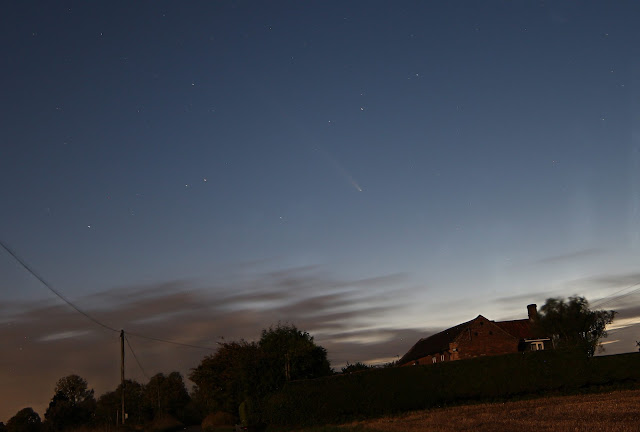
Comet Tsuchinshan-ATLAS, C/2023 A3 , Comet A3,

  A cosmic wanderer, Comet Tsuchinshan-Atlas or more commonly known as Comet A3 has traced its elliptical path through the solar system, a j...