Sunday, 1 March 2009

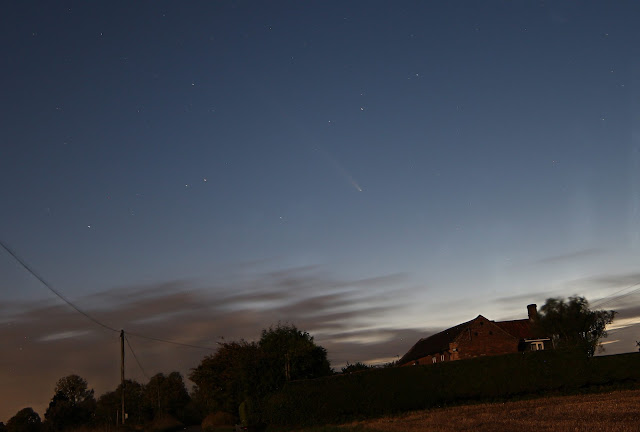
Comet Lulin (C/2007 N3)

Object: Comet Lulin (C/2007 N3)
Type: Comet
Constellation: Leo
Date: 1st March 09
Equipment: William Optics Megrez 90 Canon EOS 40D Subframes: 11 x 30 second exposures unguided at ISO1600
Processed: No darks or flats were captured. Processed in Images Plus 3.75 with a small non linear stretch or DDP
Having just given our newborn her midnight bottle and tucked her safely in her crib. I looked out the window.

Guess What I Saw ??
Finally we have had a few hours of clear sky and this was my first view of comet Lulin. I spent 15 minutes or so looking at it through my 26mm 2" meade eyepiece through the 90mm refractor. I couldnt see any colour as in the west south west direction is our local town of Watton (only 3 miles away) and a significant amount of skyglow was creeping higher and higher as the clouds and moisture content increased. .

As Lulin is composed of frozen ice, dust and gases. Cyanogen gas and diatomic carbon present in it, when irradiated by sunlight, make it appear green.

I quickly connected up the camera and for the first time used Images plus 3.75 DSLR control for a series of exposures. This image was taken between 1.50 am and About 2.15 am Several frames removed from stacking as cloud passed by. I stacked them to keep the stars at pinpoint so the comets nucleus looks a little elongated. I also used the windows picture viewer and flicked through all the frames at high speed and it was amazing to see how fast the comet is now now moving across the fixed background stars. If I can find a simple animation programme I will will make an animation of its motion.

I am amazed there was a secondary point of interest here. The tail of the comet has passed across 4 NGC galaxies marked on the frame. The faintest of which is mag 15.00 and I can just confirm its there. Not bad for 5 and a half minutes of exposure.

Not the best pic I have taken by far simply because of the sky quality and all I kept was 11 subs from the 30 or so I had taken, A fraction on the heavy side of processing to see the tail and those 4 galaxies.
For fear of no more clear nights I reflect on another beautiful looking comet and the thought of its journey and possible return in 50 million years time.
God speed comet Lulin.

Wednesday, 25 February 2009

A new Star

WOW AMAZING

I saw the birth of a new star last night.
Things went supernova from nebulous region in the constellation of the Norfolk & Norwich Hospital at 22.58 UT. It was subsequently named by it co discovers Katie & Malcolm to the name of Daisy Grace Dent. As new born stars go she was a bit of a lightweight at 6lb 7oz but already showing signs of a cavernous black hole at her centre. A rocket trip returned to her to starbase at dawn this morning after a final countdown of nearly 20 hours. All crew members are well and doing fine.

Saturday, 14 February 2009

M42 & NGC1977 Over Processed

This image is the same as the one below but i used some very aggressive processing using images plus 2.5. I have done this to see what info I could tease out from the stacked master image. Personally I like to keep the images clean with realistic dark backgrounds so if anything I am happy to under process to get a more pleasing result. I am certainly no expert in imaging but I enjoy the challenge of having a go.


So what did I do.

well within images plus there is a video file with a set of typical preset adjustments for a M42 found in the file named "deep sky image set" you can copy and paste these settings upon your own image , the processes include Pixel Maths, Digital Development, Brightness & levels, Saturation & brightness.

I wouldnt be happy with this as a final result but what amazes me is that the information is there. I love the way the running man leaps from his own nebula and M42,s wings completely encirle and join hands. No colour adjustments were made & I love to see the true colours shine through.
Please your comments are welcomed what do you think

Thursday, 12 February 2009

Rosette Nebula

Object: Rosette Nebula NGC 2244, NGC 2237
Type: HII Emission Nebula
Constellation: Monoceros
Date: 3rd february 09
Equipment: William Optics Megrez 90 Canon EOS 40D
Subframes: 27 x 30 second exposures unguided at ISO800 & 10 x 30 second darks. No filters were used. Stacked by Deep Sky Stacker.
Processed: In Images Plus 2.0 with a DDP stretch.

Notes: Image taken under moonlit conditions.
NGC 2237 is generally the name given to the whole of the nebulous region & NGC 2244 is the cluster thats believed to be responsible for the stellar winds from a group of O and B stars are exerting pressure on interstellar clouds that cause compression, this initiate's star formation in the nebula. This star formation is currently still ongoing.

Back In Time: At a distance of 5200 light years. It was a time when Unification of the first ancient Egyptian states marked the beginning of the Ancient Egyptian civilization.


Wednesday, 4 February 2009

M42 The Great Orion Nebula


What an amazing night transparency excelent apart from the 62% moon in the way.

I thought I would have another go at M42. I wasnt happy with the previous posted image, well that was really just a test to get the PHD to work ( still no luck ). Apologies for slightly elongated stars.

Object: M42
Type: Reflection & Emission Nebula 1270 Light Years Distant.
Constellation: Orion
Date: 24th January 09
Equipment: William Optics Megrez 90 Canon EOS 40D
Subframes: 30 x 30 second exposures unguided at ISO800 and
Processed: 10 x 30 sec darks were captured & subtracted. Stacked using Deep Sky Stacker,
Processed in Images Plus 2.0 with a DDP stretch. 10 Iterations on a adaptive Richardson Lucy deconvolution filter.
Notes: This cropped Image was taken under a 62% illuminated moon.

Any exposure over 30 seconds was badly washed with moonlight so I kept it to that and the result is excellent. I also used Deep Sky Stacker programme for the calibration and stacking it was very easy to use and a great deal quicker than manual registration of each image. I used med fine quality JPEG as I have a small problem when I ask it to use RAW even with an empty card the camera says it is full and will not take an image.

Leo Triplet


Object: M65, M66, NGC3628
Type: Galaxy Cluster
Constellation: Leo
Date: 3rd february 09
Equipment: William Optics Megrez 90 Canon EOS 40D
Subframes: 98 x 30 second exposures unguided at ISO800 & 19 x 30 second darks .
Processed: In Images Plus 2.0 with a DDP stretch. 6 Iterations on a adaptive Richardson Lucy deconvolution filter.
Notes: This cropped Image was taken under a 62% illumination from the moon hovering by the pliedies. I will play with the processing a little more I am sure I can tease a little more from the structure from the galaxies.
Back In Time: Light from these 3 started its journey 35 million years or so ago give or take an eon or so.
Occasional killer asteroids could have spawned temporary rings of debris around Earth and played a major role in changing the world climate, according to scientists. Resembling the rocky halos that encircle Saturn, one such terrestrial ring might have chilled the globe considerably about 35 million years ago.
The geologic record indicates that Earth endured a brutal cold spell at the time, possibly sparked by a debris ring that persisted from 100,000 to several million years, the New Mexico researchers said. (courtesy of newsfinder)

Saturday, 31 January 2009

Comet Lulin (C/2007 N3)


What might be the best naked-eye comet of the year is approaching the Earth and growing brighter every day. It’s Comet Lulin, named for the Chinese observatory where it was discovered in 2007.

Comet Lulin currently is in the constellation of Virgo passing the star Spica in the next couple of days, rising about 1 a.m., but as we progress through February, the comet will move with pace into the constellations of Virgo and Leo and will rise at the much more reasonable hour of 7 p.m.

Perhaps the most interesting aspect of Comet Lulin is its unusual orbit around the sun. Although it orbits in nearly the same plane that the Earth does, it does so backwards. Earth and all of the major planets orbit the sun counterclockwise as viewed from above Earth’s North Pole, but Comet Lulin is going against the flow, moving around the sun in a clockwise direction. Because it is moving in the opposite direction that Earth moves, the two will pass each other at the breakneck speed of nearly 40 miles per second, or 140,000 miles per hour.

On the night of closest approach to Earth, Feb. 24, Comet Lulin will be moving at an astounding 5 degrees per day across our line of sight. Its motion against the background stars will be evident through a small telescope or even binoculars. The comet will pass 0.41 Astronomical Units from earth and reach its closest distance to Earth on February 24, about 14.5 times the distance between the Earth and the Moon.

Another fascinating aspect of Comet Lulin’s orbit is that it is parabolic rather than elliptical. That means that Comet Lulin doesn’t make regular, periodic visits to the inner solar system, but it is in an orbit so large that this might be the very first time it has passed through the inner solar system and felt the warmth of the sun on its solidly frozen ices. Consequently, predicting the behavior of this newcomer is speculative at best. So far, it has been at or slightly ahead of its theoretical brightness curve. If this trend continues, Comet Lulin is expected to reach fourth magnitude at its peak. That’s bright enough to be seen with the unaided eye from dark, rural locations.

A pair of ordinary binoculars always enhances your view of a comet, and on the night of closest approach, Feb. 24, Comet Lulin and the bright planet Saturn will be in the same binocular field of view, providing an unforgettable sight.

A soon as possible from my location attempts will be made to photograph this newcomer to our solar system.

Long Live Comet Lulin.

Sunday, 25 January 2009

M42 The Great Orion Nebula


Object: M42
Type: Reflection & Emission Nebula 1270 Light Years Distant.
Constellation: Orion
Date: 24th January 09
Equipment: William Optics Megrez 90 Canon EOS 40D
Subframes: 4 x 30 second exposures unguided at ISO800 and
Processed: No darks or flats were captured. Processed in Images Plus 2.0 with a Moderate non linear stretch or DDP. 5 Iterations on a adaptive Richardson Lucy deconvolution filter.
Notes: This cropped Image was taken under heavy light pollution of my neighbouring town of Watton in Norfolk. M42 is the brightest nebula in the night sky buried within Orions sword and is the closest region of star formation.

Back In Time: That means when we look up in the winter sky at the nebula- a star making factory, the light started towards us in the year 739AD... For those of you who are history buffs, that is roughly five years after the death of the Venerable Bede- the monk who wrote the first history of Britain- before the Vikings started plundering their way around Europe!

Tuesday, 13 January 2009

More Observatory

The weather is cold the skies are certainly not clear so I thought I would take a few pics of the observatory and the inside.

How About a few more pics


Pic 1 Shows the new 120 watt tube heater. The 1st one died.
Pic 2 The laptop connected via underfloor cables.
Pic 3 One of the wheels that rolls the roof.
Pic 4 I have 2 of these bolts holding the roof in place.
Pic 5 The Imaging set up Guider & Canon in place.

The Moon

I have been sifting through images on my observatory laptop and found this lovely image of our closest neighbour.
A few facts

Object: Waning Gibbous 15.4 Day Old Moon
Distance: 231094 Miles
Date: 15th September 08
Equipment: William Optics Megrez 90 Canon EOS 40D Subframes: 1 x 1/8th Second
Notes: Magnitude -12.79. Pictured in the constellation if Pisces.

Wednesday, 12 November 2008

Bad Weather

Unfortunatly we have had some really luck with the weather recently and I have not done a great deal of photography.

I am In the process of designing a new website which has all my imaging aswell as a detailed construction of my observatory aswell as other things.

I am seeing a good number of visitors from other countries . I would appreciate any comments or suggestions you might have or even just say hello.

Comet Tsuchinshan-ATLAS, C/2023 A3 , Comet A3,

  A cosmic wanderer, Comet Tsuchinshan-Atlas or more commonly known as Comet A3 has traced its elliptical path through the solar system, a j...